sub class Elasmobranchii (ฉลามและกระเบน) (sharks and rays) >
Myliobatiformes (Stingrays) >
Myliobatidae (Eagle and manta rays)
Etymology: Myliobatis: Greek, mylo = mill + Greek, + Greek, batis,-idos = a ray (Raja sp.) (Ref. 45335).
More on author: Bleeker.
สิ่งแวดล้อม : สิ่งแวดล้อม / เขตภูมิอากาศ / ระดับความลึก / ระยะการกระจายสินค้า
นิเวศวิทยา
เกี่ยวกับทะเล,น้ำเค็ม สัตว์น้ำหน้าดิน; ระดับความลึก 0 - 220 m (Ref. 9862). Tropical
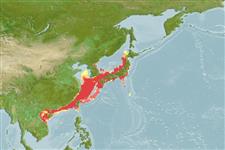
Northwest Pacific: Russia, China, South Korea and Japan.
ขนาด / น้ำหนัก / อายุ
วัยเจริญพันธุ์: Lm ? range ? - ? cm
Max length : 150 cm TL เพศผู้/กระเทย; (Ref. 9862)
This small species (attaining about 66.5 cm DW) has the following set of characters: colour of dorsal surfaces yellowish brown, usually with variable, irregular dark blotches; tail with a very weak ventral skin fold; stinging spine(s) are relatively long (longest spine 10.3-18.6% DW); interorbital space is shallowly concave in adult males; anterior margins of pectoral fins moderately convex; cranial fontanelle (visible in dorsal view without dissection) is relatively narrow with mostly straight lateral margins; claspers of adult males 6.6-10.2% DW; predorsal length 66.6-78.8% DW; each jaw with 7 rows of teeth, with a broad median row flanked by three smaller rows on each side; pectoral-fin radials 79-85 (excluding rostral propterygial radials anterior of the eyes); total vertebral centra (including synarcual) 115-124; males mature by 42.9 cm DW (Ref. 132213).
Cross section: flattened.
Found from the intertidal to the uppermost continental slope (Ref. 9862, 11230). A carnivore feeding on benthic animals. Ovoviviparous (Ref. 50449). Males and females ranged in size from 24.5-61.9 and 21.4-65.6 cm DW, respectively. Five males between 42.9 and 61.9 cm DW were found to be mature and a 41.0 cm DW male was adolescent, while 18 males between 24.5 and 32.3 cm DW were immature. A female of 65.6 cm DW was found pregnant. A reported abnormal female specimen was 66.5 cm DW and weighed 5.5 kg. The largest male examined was 61.9 cm DW had a total length of 125.7 cm (Ref. 132213).
วงจรชีวิตและพฤติกรรมการผสมพันธุ์
วัยเจริญพันธุ์ | การสืบพันธุ์ | การวางไข่ | เซลสืบพันธ์ของเพศเมีย(ไข่) | ความดกของไข่ | ตัวอ่อน
Exhibit ovoviparity (aplacental viviparity), with embryos feeding initially on yolk, then receiving additional nourishment from the mother by indirect absorption of uterine fluid enriched with mucus, fat or protein through specialised structures (Ref. 50449).
White, W.T., J. Kawauchi, S. Corrigan, E. Rochel and G.J.P. Naylor, 2015. Redescription of the eagle rays Myliobatis hamlyni Ogilby, 1911 and M. tobijei Bleeker, 1854 (Myliobatiformes: Myliobatidae) from the east Indo-West Pacific. Zootaxa 3948(3):521-548. (Ref. 132213)
สถานะบัญชีแดงของ IUCN (Ref. 130435: Version 2025-2 (Global))
ภัยคุกคามต่อมนุษย์
Traumatogenic
การใช้ของมนุษย์
การประมง: มีการค้าเพียงเล็กน้อย; การตกปลาเป็นกีฬา: ใช่
เครื่องมือ
รายงานพิเศษ
ดาวน์โหลด XML
แหล่งที่มาจากอินเตอร์เน็ต
การประมาณค่าตามแบบจำลอง
อุณหภูมิที่ต้องการ (อ้างอิง
123201): 12.8 - 24.7, mean 20.3 °C (based on 176 cells).
ดัชนีความหลากหลายทางวิวัฒนาการ (อ้างอิง
82804): PD
50 = 0.5002 [Uniqueness, from 0.5 = low to 2.0 = high].
Bayesian length-weight: a=0.00389 (0.00124 - 0.01219), b=3.08 (2.83 - 3.33), in cm total length, based on LWR estimates for this (Sub)family-body shape (Ref.
93245).
ระดับชั้นอาหาร (อ้างอิง
69278): 3.5 ±0.37 se; based on food items.
ความสามารถในการกลับคืนสู่ปกติ (อ้างอิง
120179): ต่ำ, เวลาต่ำสุดที่จะทำให้ประชากรเพิ่มขึ้นเป็น 2 เท่าใช้เวลา 4.5 - 14 ปี (Fec assumed to be <100).
ความเสี่ยงต่อการตกปลา (Ref.
59153): Very high vulnerability (90 of 100).
🛈