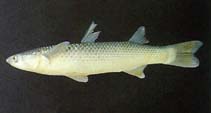
Taxonomic Remarks
In genus Planiliza (Durand et al., 2015: Ref. 114224).
Entorno: milieu / zona climática / rango de profundidad / gama de distribución
Ecología
marino; agua dulce; salobre pelagic-neritic; catadromo (Ref. 46888); rango de profundidad 5 - 10 m (Ref. 559). Temperate; 53°N - 18°N, 105°E - 146°E
Northwest Pacific: Hokkaido southward to Kyushu, Japan; Amur River southward to Xiamen through the Korean Peninsula (Ref. 41299). Reported from Vietnam (Ref. 9706). Introduced in the Aegean Sea (Ref. 113897), Black Sea and the Mediterranean (Ref. 101091).
Longitud en la primera madurez / Tamaño / Peso / Edad
Madurez: Lm ?, range 48 - ? cm
Max length : 80.0 cm TL macho / no sexado; (Ref. 56557); common length : 50.0 cm TL macho / no sexado; (Ref. 9137); peso máximo publicado: 5.0 kg (Ref. 56557)
Descripción breve
Claves de identificación | Morfología | Morfometría
Adults inhabit shallow coastal waters as well as freshwater regions of rivers (Ref. 41299). Very common in the rivers discharging into Peter the Great Bay; enter freshwater. Juveniles spend their first year in freshwater then migrate to sea to breed (Ref. 59043). Large concentrations of fry-of-the-year measuring 3.1-6.2 cm in the mouths of rivers in August. Length in the Black Sea is usually 20-30 cm but may reach 43 cm; length in the Atlantic Ocean may reach 50 cm (Ref. 2058). Omnivorous (Ref. 9137). Oviparous, eggs are pelagic and non-adhesive (Ref. 205). Alien Invasive: In Azov Sea, it is now the most abundant mugilid species. Along shores of Black Sea, its expansion corresponds to a sharp decline of native species of Mugilidae, which it apparently replaces (Ref. 59043).
Juveniles spend their first year in freshwater then migrate to sea to breed (Ref. 59043). Also Ref. 205.
Masuda, H. and G.R. Allen, 1993. Meeresfische der Welt - Groß-Indopazifische Region. Tetra Verlag, Herrenteich, Melle. 528 p. (Ref. 9137)
Situación en la Lista Roja de la UICN (Ref. 130435: Version 2025-2 (Global))
Amenaza para el ser humano
Harmless
Usos humanos
Pesquerías: comercial
Herramientas
Informes especiales
Descargar XML
Fuentes de Internet
Estimaciones basadas en modelos
Temperatura preferida (Referencia
123201): 20.2 - 25, mean 22.4 °C (based on 103 cells).
Índice de diversidad filogenética (Referencia
82804): PD
50 = 0.5001 [Uniqueness, from 0.5 = low to 2.0 = high].
Bayesian length-weight: a=0.00933 (0.00618 - 0.01409), b=2.95 (2.83 - 3.07), in cm total length, based on LWR estimates for this species & Genus-body shape (Ref.
93245).
Nivel trófico (Referencia
69278): 2.5 ±0.19 se; based on food items.
Generation time: 8.1 ( na - na) years. Estimated as median ln(3)/K based on 2
growth studies.
Resiliencia (Referencia
120179): Bajo, población duplicada en un tiempo mínimo de 4.5-14 años (0.13-0.23; tm=2-5;).
Vulnerabilidad pesquera (Ref.
59153): High vulnerability (58 of 100).
🛈
Nutrientes (Ref.
124155): Calcium = 34.5 [13.5, 102.8] mg/100g; Iron = 0.427 [0.194, 0.861] mg/100g; Protein = 18.9 [17.2, 20.5] %; Omega3 = 0.703 [0.309, 1.611] g/100g; Selenium = 8.06 [3.41, 19.24] μg/100g; VitaminA = 10.2 [2.5, 43.4] μg/100g; Zinc = 0.846 [0.550, 1.305] mg/100g (wet weight);