Klassifizierung / Names
Namen | Synonyme | Catalog of Fishes(Gattung, Arten) | ITIS | CoL | WoRMS | Cloffa
Elasmobranchii (Haie und Rochen) (sharks and rays) >
Myliobatiformes (Stingrays) >
Potamotrygonidae (River stingrays) > Potamotrygoninae
Etymology: Potamotrygon: Greek, potamos = river + Greek, trygon = a sting ray (Ref. 45335).
More on authors: Müller & Henle.
Taxonomic Remarks
Authorship controversial, but follows Rosa (1985a) in crediting original species name to Müller & Henle and not to d’Orbigny. Species later redescribed by Müller & Henle (1841) based on five additional specimens, but these do not have type status (the action of Castex, 1969, in designating a lectotype is therefore not valid; Rosa, 1985a). May be confused in the literature with P. orbignyi (occurrences in French Guiana, Guyana, Suriname, Venezuela). Reproductive biology unknown. Additional references: Bertin (1939), Castex (1965); Achenbach & Achenbach (1976), Compagno & Cook (1995).
Umwelt: Milieu / Klimazone / Tiefenbereich / Verbreitungsgebiet
Ökologie
; süßwasser benthopelagisch; dH range: 10 - ?; potamodrom (Ref. 51243). Subtropical; 24°C - 26°C (Ref. 12468)
South America: Paraná-Paraguay River basin.
Größe / Gewicht / Alter
Geschlechtsreife: Lm ? range ? - ? cm
Max length : 40.0 cm WD Männchen/unbestimmt; (Ref. 27188); max. veröff. Gewicht: 15.0 kg (Ref. 27548)
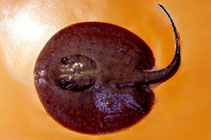
Occurs in marshy zones where it is frequently found partially hidden in the sandy bottom. This behavior, associated with its perfect immobility and its capacity to undergo homochromy, makes it practically undetectable to the eye. Like all species of this family, P. hystrix has a tail which is equipped with one or more spines which fall spontaneously and are replaced 2 or 3 times a year. At a length of 4 to 6 cm, the spine is a barbed, flattened skeletal formation inserted dorsally in the middle portion of the tail. Its structure is similar to that of a tooth and appears as an ivory cone covered with enamel. The spine is coated with an extremely toxic mucus produced by the cells of the skin and inflicts very painful wounds (Ref. 27188).
Lebenszyklus und Paarungsverhalten
Geschlechtsreife | Fortpflanzung | Ablaichen | Eier | Fruchtbarkeit | Larven
Compagno, L.J.V., 1999. Checklist of living elasmobranchs. p. 471-498. In W.C. Hamlett (ed.) Sharks, skates, and rays: the biology of elasmobranch fishes. Johns Hopkins University Press, Maryland. (Ref. 35766)
IUCN Rote Liste Status (Ref. 130435: Version 2025-2 (Global))
Bedrohung für Menschen
Harmless
Nutzung durch Menschen
Fischereien: weniger kommerziell; Aquarium: Öffentliche Aquarien
Tools
Zusatzinformationen
Download XML
Internet Quellen
Schätzungen auf der Grundlage von Modellen
Phylogenetischer Diversitätsindex (Ref.
82804): PD
50 = 0.5000 [Uniqueness, from 0.5 = low to 2.0 = high].
Bayesian length-weight: a=0.01000 (0.00244 - 0.04107), b=3.04 (2.81 - 3.27), in cm total length, based on all LWR estimates for this body shape (Ref.
93245).
Trophische Ebene (Ref.
69278): 3.2 ±0.4 se; based on size and trophs of closest relatives
Widerstandsfähigkeit (Ref.
120179): sehr niedrig, Verdopplung der Population dauert mehr als 14 Jahre. (Assuming Fec<10).
Anfälligkeit der Fischerei (Ref.
59153): High vulnerability (58 of 100).
🛈