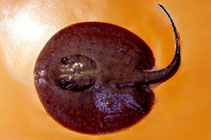
Classificazione / Nomi
Nomi Comuni | Sinonimi | Catalog of Fishes(Genere, Specie) | ITIS | CoL | WoRMS | Cloffa
Elasmobranchi (squali e razze) (sharks and rays) >
Myliobatiformes (Stingrays) >
Potamotrygonidae (River stingrays) > Potamotrygoninae
Etymology: Potamotrygon: Greek, potamos = river + Greek, trygon = a sting ray (Ref. 45335).
More on authors: Müller & Henle.
Taxonomic Remarks
Authorship controversial, but follows Rosa (1985a) in crediting original species name to Müller & Henle and not to d’Orbigny. Species later redescribed by Müller & Henle (1841) based on five additional specimens, but these do not have type status (the action of Castex, 1969, in designating a lectotype is therefore not valid; Rosa, 1985a). May be confused in the literature with P. orbignyi (occurrences in French Guiana, Guyana, Suriname, Venezuela). Reproductive biology unknown. Additional references: Bertin (1939), Castex (1965); Achenbach & Achenbach (1976), Compagno & Cook (1995).
Ambiente: milieu / zona climatica / distribuzione batimetrica / gamma di distribuzione
Ecologia
; acqua dolce benthopelagico; dH range: 10 - ?; potamodromo (Ref. 51243). Subtropical; 24°C - 26°C (Ref. 12468)
South America: Paraná-Paraguay River basin.
Dimensione / Peso / Età
Maturità: Lm ? range ? - ? cm
Max length : 40.0 cm WD maschio/sesso non determinato; (Ref. 27188); peso massimo pubblicato: 15.0 kg (Ref. 27548)
Occurs in marshy zones where it is frequently found partially hidden in the sandy bottom. This behavior, associated with its perfect immobility and its capacity to undergo homochromy, makes it practically undetectable to the eye. Like all species of this family, P. hystrix has a tail which is equipped with one or more spines which fall spontaneously and are replaced 2 or 3 times a year. At a length of 4 to 6 cm, the spine is a barbed, flattened skeletal formation inserted dorsally in the middle portion of the tail. Its structure is similar to that of a tooth and appears as an ivory cone covered with enamel. The spine is coated with an extremely toxic mucus produced by the cells of the skin and inflicts very painful wounds (Ref. 27188).
Ciclo vitale e comportamento di accoppiamento
Maturità | Riproduzione | Deposizione | Uova | Fecondità | Larve
Compagno, L.J.V., 1999. Checklist of living elasmobranchs. p. 471-498. In W.C. Hamlett (ed.) Sharks, skates, and rays: the biology of elasmobranch fishes. Johns Hopkins University Press, Maryland. (Ref. 35766)
Stato della Lista Rossa IUCN (Ref. 130435: Version 2025-2 (Global))
Minaccia per l'uomo
Harmless
Usi umani
Pesca: scarso interesse commerciale; Acquario: Acquari pubblici
Strumenti
Rapporti speciali
Scarica XML
Fonti Internet
Stime basate su modelli
Indice di diversità filogenetica (Fonte Biblio.
82804): PD
50 = 0.5000 [Uniqueness, from 0.5 = low to 2.0 = high].
Bayesian length-weight: a=0.01000 (0.00244 - 0.04107), b=3.04 (2.81 - 3.27), in cm total length, based on all LWR estimates for this body shape (Ref.
93245).
Livello trofico (Fonte Biblio.
69278): 3.2 ±0.4 se; based on size and trophs of closest relatives
Resilienza (Fonte Biblio.
120179): Molto basso, tempo minimo di raddoppiamento della popolazione più di 14 anni (Assuming Fec<10).
Vulnerabilità della pesca (Ref.
59153): High vulnerability (58 of 100).
🛈