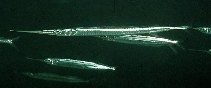
>
Beloniformes (Needle fishes) >
Belonidae (Needlefishes)
Etymology: Platybelone: Greek, platys = flat + Greek, belone = needle; any fish with sharp pointed snout; also Pierre Belon, 1517-64, French zoologist born in Le Mans. Professor at the College de France, author of " La nature et diversité des poissons", 1551 (Ref. 45335).
More on author: Bennett.
Taxonomic Remarks
Considered mostly as a subspecies in the literature. Therefore the upraise at species rank here is considered as a provisionally accepted name, until more works are conducted on P. argalus susbepcies to fix their status.
Considered mostly as a subspecies in the literature. Therefore the upraise at species rank here is considered as a provisionally accepted name, until more works are conducted on P. argalus susbepcies to fix their status.
Ambiente: milieu / zona climatica / distribuzione batimetrica / gamma di distribuzione
Ecologia
marino associati a barriera corallina; oceanodromo (Ref. 51243); distribuzione batimetrica 0 - 2 m (Ref. 58302). Tropical; 27°N - 46°S, 51°E - 109°W
Indo-Pacific: East Africa to the Hawaiian and Tuamoto islands, north to the Ogasawara Islands. The subspecies platura from the Red Sea to Persian Gulf, platyura in the rest of the Indo-Pacific, and argalus in the tropical Atlantic (Ref. 37816).
Dimensione / Peso / Età
Maturità: Lm ? range ? - ? cm
Max length : 45.0 cm TL maschio/sesso non determinato; (Ref. 89467); common length : 30.0 cm SL maschio/sesso non determinato; (Ref. 30573)
Spine dorsali (totale) : 0; Raggi dorsali molli (totale) : 12 - 15; Spine anali: 0; Raggi anali molli: 15 - 20; Vertebre: 62 - 75. Gill rakers present; dorsal fin rays few, 12-15; caudal peduncle greatly depressed with very large keel on each side (Ref. 9682). See also Ref. 1602.
Body shape (shape guide): eel-like; Cross section: circular.
Inhabits offshore surface waters but is particularly abundant around islands (Ref. 9682). Probably the most common needlefish of reef flats, lagoons and bays where it occurs in groups of a few to several dozen. Carnivorous, feeding mainly on small fishes; marketed fresh (Ref. 9682). Oviparous (Ref. 205). Eggs may be found attached to objects in the water by tendrils on the egg's surface (Ref. 205).
Ciclo vitale e comportamento di accoppiamento
Maturità | Riproduzione | Deposizione | Uova | Fecondità | Larve
Randall, J.E., G.R. Allen and R.C. Steene, 1990. Fishes of the Great Barrier Reef and Coral Sea. University of Hawaii Press, Honolulu, Hawaii. 506 p. (Ref. 2334)
Stato della Lista Rossa IUCN (Ref. 130435: Version 2025-2 (Global))
Minaccia per l'uomo
Harmless
Usi umani
Pesca: di nessun interesse; Pesce da pesca sportiva: si
Strumenti
Rapporti speciali
Scarica XML
Fonti Internet
Stime basate su modelli
Temperatura preferita (Fonte Biblio.
123201): 26.3 - 29, mean 28 °C (based on 334 cells).
Indice di diversità filogenetica (Fonte Biblio.
82804): PD
50 = 0.5078 [Uniqueness, from 0.5 = low to 2.0 = high].
Bayesian length-weight: a=0.00112 (0.00044 - 0.00287), b=3.05 (2.82 - 3.28), in cm total length, based on LWR estimates for this (Sub)family-body shape (Ref.
93245).
Livello trofico (Fonte Biblio.
69278): 4.2 ±0.73 se; based on food items.
Resilienza (Fonte Biblio.
120179): Alto, tempo minimo di raddoppiamento della popolazione meno di 15 mesi (Preliminary K or Fecundity.).
Vulnerabilità della pesca (Ref.
59153): Low to moderate vulnerability (35 of 100).
🛈
Nutrienti (Ref.
124155): Calcium = 94 [27, 374] mg/100g; Iron = 0.554 [0.248, 1.538] mg/100g; Protein = 17.3 [15.3, 19.3] %; Omega3 = 0.107 [0.043, 0.322] g/100g; Selenium = 18.1 [8.4, 48.4] μg/100g; VitaminA = 205 [57, 789] μg/100g; Zinc = 1.01 [0.59, 1.64] mg/100g (wet weight);