>
Beloniformes (Needle fishes) >
Belonidae (Needlefishes)
Etymology: Platybelone: Greek, platys = flat + Greek, belone = needle; any fish with sharp pointed snout; also Pierre Belon, 1517-64, French zoologist born in Le Mans. Professor at the College de France, author of " La nature et diversité des poissons", 1551 (Ref. 45335).
More on author: Bennett.
Taxonomic Remarks
Considered mostly as a subspecies in the literature. Therefore the upraise at species rank here is considered as a provisionally accepted name, until more works are conducted on P. argalus susbepcies to fix their status.
Considered mostly as a subspecies in the literature. Therefore the upraise at species rank here is considered as a provisionally accepted name, until more works are conducted on P. argalus susbepcies to fix their status.
Entorno: milieu / zona climática / rango de profundidad / gama de distribución
Ecología
marino asociado a arrecife; oceanodromo (Ref. 51243); rango de profundidad 0 - 2 m (Ref. 58302). Tropical; 27°N - 46°S, 51°E - 109°W
Indo-Pacific: East Africa to the Hawaiian and Tuamoto islands, north to the Ogasawara Islands. The subspecies platura from the Red Sea to Persian Gulf, platyura in the rest of the Indo-Pacific, and argalus in the tropical Atlantic (Ref. 37816).
Tamaño / Peso / Edad
Madurez: Lm ? range ? - ? cm
Max length : 45.0 cm TL macho / no sexado; (Ref. 89467); common length : 30.0 cm SL macho / no sexado; (Ref. 30573)
Espinas dorsales (total) : 0; Radios blandos dorsales (total) : 12 - 15; Espinas anales: 0; Radios blandos anales: 15 - 20; Vértebra: 62 - 75. Gill rakers present; dorsal fin rays few, 12-15; caudal peduncle greatly depressed with very large keel on each side (Ref. 9682). See also Ref. 1602.
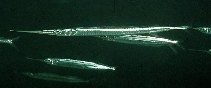
Body shape (shape guide): eel-like; Cross section: circular.
Inhabits offshore surface waters but is particularly abundant around islands (Ref. 9682). Probably the most common needlefish of reef flats, lagoons and bays where it occurs in groups of a few to several dozen. Carnivorous, feeding mainly on small fishes; marketed fresh (Ref. 9682). Oviparous (Ref. 205). Eggs may be found attached to objects in the water by tendrils on the egg's surface (Ref. 205).
Ciclo vital y comportamiento de apareamiento
Madurez | Reproducción | Puesta | Huevos | Fecundidad | Larva
Randall, J.E., G.R. Allen and R.C. Steene, 1990. Fishes of the Great Barrier Reef and Coral Sea. University of Hawaii Press, Honolulu, Hawaii. 506 p. (Ref. 2334)
Situación en la Lista Roja de la UICN (Ref. 130435: Version 2025-2 (Global))
Amenaza para el ser humano
Harmless
Usos humanos
Pesquerías: sin interés; pesca deportiva: si
Herramientas
Informes especiales
Descargar XML
Fuentes de Internet
Estimaciones basadas en modelos
Temperatura preferida (Referencia
123201): 26.3 - 29, mean 28 °C (based on 334 cells).
Índice de diversidad filogenética (Referencia
82804): PD
50 = 0.5078 [Uniqueness, from 0.5 = low to 2.0 = high].
Bayesian length-weight: a=0.00112 (0.00044 - 0.00287), b=3.05 (2.82 - 3.28), in cm total length, based on LWR estimates for this (Sub)family-body shape (Ref.
93245).
Nivel trófico (Referencia
69278): 4.2 ±0.73 se; based on food items.
Resiliencia (Referencia
120179): Alto, población duplicada en un tiempo mínimo inferior a 15 meses (Preliminary K or Fecundity.).
Vulnerabilidad pesquera (Ref.
59153): Low to moderate vulnerability (35 of 100).
🛈
Nutrientes (Ref.
124155): Calcium = 94 [27, 374] mg/100g; Iron = 0.554 [0.248, 1.538] mg/100g; Protein = 17.3 [15.3, 19.3] %; Omega3 = 0.107 [0.043, 0.322] g/100g; Selenium = 18.1 [8.4, 48.4] μg/100g; VitaminA = 205 [57, 789] μg/100g; Zinc = 1.01 [0.59, 1.64] mg/100g (wet weight);