>
Beloniformes (Needle fishes) >
Belonidae (Needlefishes)
Etymology: Strongylura: Greek, strongylos = round + Greek, oura = tail (Ref. 45335).
More on author: Bleeker.
Ambiente: milieu / zona climatica / distribuzione batimetrica / gamma di distribuzione
Ecologia
marino; salmastro associati a barriera corallina; oceanodromo (Ref. 51243); distribuzione batimetrica 0 - 3 m (Ref. 86942). Tropical; 30°N - 40°S, 30°E - 180°E
Indo-West Pacific: Somalia (Ref. 30573) and Tanzania to Durban, South Africa (Ref. 3130) east to Pakistan, India, Sri Lanka and southeast Asia to New Guinea, Australia, and the Philippines. Reported from southern China (Ref. 5317). The Australian population is regarded as subspecies Strongylura leiura ferox by Parin (1967) (Ref. 1602).
Dimensione / Peso / Età
Maturità: Lm ? range ? - ? cm
Max length : 100.0 cm TL maschio/sesso non determinato; (Ref. 3678); common length : 35.0 cm OT maschio/sesso non determinato; (Ref. 9682)
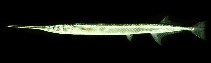
Spine dorsali (totale) : 0; Raggi dorsali molli (totale) : 17 - 21; Spine anali: 0; Raggi anali molli: 23 - 25. Laterally compressed; origin of dorsal fin over 7th-10th ray of anal fin; dorsal fin rays 17-21; anal fin rays 23-25; caudal peduncle without lateral keels; caudal fin emarginate; predorsal scales moderately small, 130-180 (Ref. 9682). Caudal fin sub truncate; a black bar on cheek between opercle and preopercle; greenish dorsally, grading to silvery white ventrally.
Body shape (shape guide): elongated; Cross section: compressed.
Inhabit coastal waters and estuaries (Ref. 5213). Larvae and early juveniles are found in mangroves (Ref. 43081). Feed mainly on small fishes (Ref. 3130) and crustaceans (Ref. 43081). Oviparous (Ref. 205). Eggs may be found attached to objects in the water by tendrils on the egg's surface (Ref. 205). Marketed fresh (Ref. 9682).
Ciclo vitale e comportamento di accoppiamento
Maturità | Riproduzione | Deposizione | Uova | Fecondità | Larve
Randall, J.E., G.R. Allen and R.C. Steene, 1990. Fishes of the Great Barrier Reef and Coral Sea. University of Hawaii Press, Honolulu, Hawaii. 506 p. (Ref. 2334)
Stato della Lista Rossa IUCN (Ref. 130435: Version 2025-2 (Global))
Minaccia per l'uomo
Harmless
Usi umani
Pesca: commerciale; Pesce da pesca sportiva: si
Strumenti
Rapporti speciali
Scarica XML
Fonti Internet
Stime basate su modelli
Temperatura preferita (Fonte Biblio.
123201): 24.7 - 29.3, mean 28.5 °C (based on 2798 cells).
Indice di diversità filogenetica (Fonte Biblio.
82804): PD
50 = 0.5000 [Uniqueness, from 0.5 = low to 2.0 = high].
Bayesian length-weight: a=0.00148 (0.00077 - 0.00283), b=3.05 (2.89 - 3.21), in cm total length, based on LWR estimates for this species & Genus-body shape (Ref.
93245).
Livello trofico (Fonte Biblio.
69278): 3.9 ±0.64 se; based on food items.
Resilienza (Fonte Biblio.
120179): Medio, tempo minimo di raddoppiamento della popolazione 1.4 - 4.4 anni (Preliminary K or Fecundity.).
Vulnerabilità della pesca (Ref.
59153): High vulnerability (60 of 100).
🛈
Nutrienti (Ref.
124155): Calcium = 54.1 [17.3, 251.2] mg/100g; Iron = 0.425 [0.198, 1.184] mg/100g; Protein = 17.6 [15.6, 19.7] %; Omega3 = 0.103 [0.041, 0.287] g/100g; Selenium = 25.4 [11.8, 57.8] μg/100g; VitaminA = 72.1 [21.3, 254.1] μg/100g; Zinc = 1.11 [0.71, 1.73] mg/100g (wet weight);