>
Beloniformes (Needle fishes) >
Belonidae (Needlefishes)
Etymology: Strongylura: Greek, strongylos = round + Greek, oura = tail (Ref. 45335).
More on author: Bleeker.
Entorno: milieu / zona climática / rango de profundidad / gama de distribución
Ecología
marino; salobre asociado a arrecife; oceanodromo (Ref. 51243); rango de profundidad 0 - 3 m (Ref. 86942). Tropical; 30°N - 40°S, 30°E - 180°E
Indo-West Pacific: Somalia (Ref. 30573) and Tanzania to Durban, South Africa (Ref. 3130) east to Pakistan, India, Sri Lanka and southeast Asia to New Guinea, Australia, and the Philippines. Reported from southern China (Ref. 5317). The Australian population is regarded as subspecies Strongylura leiura ferox by Parin (1967) (Ref. 1602).
Tamaño / Peso / Edad
Madurez: Lm ? range ? - ? cm
Max length : 100.0 cm TL macho / no sexado; (Ref. 3678); common length : 35.0 cm OT macho / no sexado; (Ref. 9682)
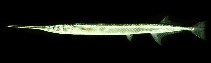
Espinas dorsales (total) : 0; Radios blandos dorsales (total) : 17 - 21; Espinas anales: 0; Radios blandos anales: 23 - 25. Laterally compressed; origin of dorsal fin over 7th-10th ray of anal fin; dorsal fin rays 17-21; anal fin rays 23-25; caudal peduncle without lateral keels; caudal fin emarginate; predorsal scales moderately small, 130-180 (Ref. 9682). Caudal fin sub truncate; a black bar on cheek between opercle and preopercle; greenish dorsally, grading to silvery white ventrally.
Body shape (shape guide): elongated; Cross section: compressed.
Inhabit coastal waters and estuaries (Ref. 5213). Larvae and early juveniles are found in mangroves (Ref. 43081). Feed mainly on small fishes (Ref. 3130) and crustaceans (Ref. 43081). Oviparous (Ref. 205). Eggs may be found attached to objects in the water by tendrils on the egg's surface (Ref. 205). Marketed fresh (Ref. 9682).
Ciclo vital y comportamiento de apareamiento
Madurez | Reproducción | Puesta | Huevos | Fecundidad | Larva
Randall, J.E., G.R. Allen and R.C. Steene, 1990. Fishes of the Great Barrier Reef and Coral Sea. University of Hawaii Press, Honolulu, Hawaii. 506 p. (Ref. 2334)
Situación en la Lista Roja de la UICN (Ref. 130435: Version 2025-2 (Global))
Amenaza para el ser humano
Harmless
Usos humanos
Pesquerías: comercial; pesca deportiva: si
Herramientas
Informes especiales
Descargar XML
Fuentes de Internet
Estimaciones basadas en modelos
Temperatura preferida (Referencia
123201): 24.7 - 29.3, mean 28.5 °C (based on 2798 cells).
Índice de diversidad filogenética (Referencia
82804): PD
50 = 0.5000 [Uniqueness, from 0.5 = low to 2.0 = high].
Bayesian length-weight: a=0.00148 (0.00077 - 0.00283), b=3.05 (2.89 - 3.21), in cm total length, based on LWR estimates for this species & Genus-body shape (Ref.
93245).
Nivel trófico (Referencia
69278): 3.9 ±0.64 se; based on food items.
Resiliencia (Referencia
120179): Medio, población duplicada en un tiempo mínimo de 1.4-4.4 años (Preliminary K or Fecundity.).
Vulnerabilidad pesquera (Ref.
59153): High vulnerability (60 of 100).
🛈
Nutrientes (Ref.
124155): Calcium = 54.1 [17.3, 251.2] mg/100g; Iron = 0.425 [0.198, 1.184] mg/100g; Protein = 17.6 [15.6, 19.7] %; Omega3 = 0.103 [0.041, 0.287] g/100g; Selenium = 25.4 [11.8, 57.8] μg/100g; VitaminA = 72.1 [21.3, 254.1] μg/100g; Zinc = 1.11 [0.71, 1.73] mg/100g (wet weight);