Ikan bertulang rawan (sharks and rays) >
Rajiformes (Skates and rays) >
Arhynchobatidae (Softnose skates)
Etymology: Bathyraja: Greek, bathys = deep + Latin, raja, -ae = a ray (Raja sp) (Ref. 45335); spinosissima: Name from Latin 'spinosus' meaning thorny, referring to the prickles on both the ventral and dorsal surface.
More on authors: Beebe & Tee-Van.
Lingkungan: lingkungan / zona iklim / kisaran kedalaman / jangkauan distribusi
Ekologi
laut batidemersal; kisaran kedalaman 800 - 2938 m (Ref. 50610). Deep-water
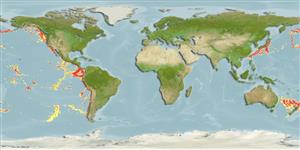
North Pacific: from the Bering Sea, south to the Galapagos Islands and Costa Rica.
Ukuran / Berat / umur
Kematangan: Lm ? range ? - ? cm
Max length : 200 cm TL jantan/; (Ref. 126515)
deskripsi pendek
Kunci identifiaksi (pengenalan) | Morfologi | Morfometrik
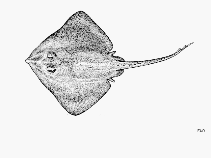
This large skates (200.3 cm TL), with large disc length and width (44.1-56.9 and 50.6-67.3% TL, respectively) are distinguished by the following: pectorals with rounded apices; head moderately long (14.0-20.5 % TL), interspiracular length large (9.1-12.2% TL), mouth width large (6.1-13.0% TL); teeth in 31-33 rows on upper jaw and in 24-31 rows on lower jaw; total vertebrae 137; dorsal and ventral surfaces are covered with prickles; thorns usually absent on dorsal surface, with tail thorns (22-28), interdorsal thorns weakly developed or absent (0-1), no middorsal, nuchal, and scapular thorns. Colouration: dorsal pale white to grey, while ventral is pale white; outer edges of pectorals dark (Ref. 126515).
Cross section: flattened.
Found in deep waters to almost 3,000 m, making it one of the deepest dwelling skates; prefer cold temperatures compared to its congeners. Feeds on deep-water benthic fishes. Size at maturity for males is unknown, for female specimens, size at maturity at 98 cm TL; with size at birth 25 cm TL. Egg cases are large compared to its congeners (9.2 cm TL); colour plum brown and longitudinally weakly striated, with both surfaces of the case plush-like to the touch. Horns with posterior ones curve inwards and with narrow at tips (Ref. 126515).
Oviparous, paired eggs are laid. Embryos feed solely on yolk (Ref. 50449). Eggs have horn-like projections on the shell (Ref. 205).
Knuckey, J.D.S. and D.A. Ebert, 2022. A taxonomic revision of Northeast Pacific softnose skates (Rajiformes: Arhynchobatidae: Bathyraja Ishiyama). Zootaxa 5142(1):1-89. (Ref. 126515)
Status IUCN Red List (Ref. 130435: Version 2025-2 (Global))
ancaman kepada manusia
Harmless
penggunaan manusia
Perikanan: tidak ada kepentingan
Alat, peralatan
laporan khas
muat turun XML
Sumber internet
Estimasi berdasarkan model
Suhu yang disukai (Acuan
123201): 1.6 - 2.1, mean 1.8 °C (based on 438 cells).
Indeks keanekaragaman filogenetik (Acuan
82804): PD
50 = 0.5000 [Uniqueness, from 0.5 = low to 2.0 = high].
Bayesian length-weight: a=0.00562 (0.00296 - 0.01067), b=3.13 (2.97 - 3.29), in cm total length, based on LWR estimates for this Genus-body shape (Ref.
93245).
Tingkat Trofik (Acuan
69278): 4.2 ±0.8 se; based on size and trophs of closest relatives
Daya lenting (Acuan
120179): Rendah, Waktu penggandaan populasi minimum 4.5 - 14 tahun (Fec assumed to be <100).
Kerentanan Penangkapan Ikan (Ref.
59153): Very high vulnerability (90 of 100).
🛈