Elasmobranchii (hajar och rockor) (sharks and rays) >
Rajiformes (Skates and rays) >
Arhynchobatidae (Softnose skates)
Etymology: Bathyraja: Greek, bathys = deep + Latin, raja, -ae = a ray (Raja sp) (Ref. 45335); spinosissima: Name from Latin 'spinosus' meaning thorny, referring to the prickles on both the ventral and dorsal surface.
More on authors: Beebe & Tee-Van.
Miljö: miljö / Klimatzon / djupintervall / distributionsområde
Ekologi
marina djupbottenlevande; djupintervall 800 - 2938 m (Ref. 50610). Deep-water
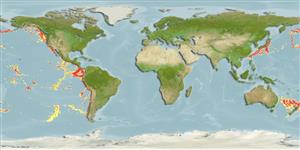
North Pacific: from the Bering Sea, south to the Galapagos Islands and Costa Rica.
Storlek / Vikt / Ålder
Könsmognad: Lm ? range ? - ? cm
Max length : 200 cm TL hane/ej könsbestämd; (Ref. 126515)
Kort beskrivning
Bestämningsnycklar | Morfologi | Morfometri
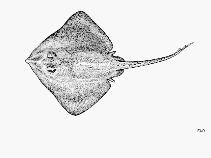
This large skates (200.3 cm TL), with large disc length and width (44.1-56.9 and 50.6-67.3% TL, respectively) are distinguished by the following: pectorals with rounded apices; head moderately long (14.0-20.5 % TL), interspiracular length large (9.1-12.2% TL), mouth width large (6.1-13.0% TL); teeth in 31-33 rows on upper jaw and in 24-31 rows on lower jaw; total vertebrae 137; dorsal and ventral surfaces are covered with prickles; thorns usually absent on dorsal surface, with tail thorns (22-28), interdorsal thorns weakly developed or absent (0-1), no middorsal, nuchal, and scapular thorns. Colouration: dorsal pale white to grey, while ventral is pale white; outer edges of pectorals dark (Ref. 126515).
Cross section: flattened.
Found in deep waters to almost 3,000 m, making it one of the deepest dwelling skates; prefer cold temperatures compared to its congeners. Feeds on deep-water benthic fishes. Size at maturity for males is unknown, for female specimens, size at maturity at 98 cm TL; with size at birth 25 cm TL. Egg cases are large compared to its congeners (9.2 cm TL); colour plum brown and longitudinally weakly striated, with both surfaces of the case plush-like to the touch. Horns with posterior ones curve inwards and with narrow at tips (Ref. 126515).
Livscykel och parningsbeteende
Könsmognad | Reproduktion | Lek | Ägg | Fekunditet | Larver
Oviparous, paired eggs are laid. Embryos feed solely on yolk (Ref. 50449). Eggs have horn-like projections on the shell (Ref. 205).
Knuckey, J.D.S. and D.A. Ebert, 2022. A taxonomic revision of Northeast Pacific softnose skates (Rajiformes: Arhynchobatidae: Bathyraja Ishiyama). Zootaxa 5142(1):1-89. (Ref. 126515)
Status på IUCN:s rödlista (Ref. 130435: Version 2025-2 (Global))
Hot mot människor
Harmless
Mänskliga användningsområden
Fiskeri: saknar intresse
Verktyg
Särskilda rapporter
Ladda ner XML
Internet-källor
Uppskattningar baserade på modeller
Önskad temperatur (Ref.
123201): 1.6 - 2.1, mean 1.8 °C (based on 438 cells).
Index för fylogenetisk mångfald (Ref.
82804): PD
50 = 0.5000 [Uniqueness, from 0.5 = low to 2.0 = high].
Bayesian length-weight: a=0.00562 (0.00296 - 0.01067), b=3.13 (2.97 - 3.29), in cm total length, based on LWR estimates for this Genus-body shape (Ref.
93245).
Trofisk nivå (Ref.
69278): 4.2 ±0.8 se; based on size and trophs of closest relatives
Resiliens (Ref.
120179): Låg, lägsta populationsfördubblingstid 4,5-14 år (Fec assumed to be <100).
Sårbarhet i fisket (Ref.
59153): Very high vulnerability (90 of 100).
🛈