>
Gadiformes (Cods) >
Phycidae (Phycid hakes)
Etymology: Phycis: Taken from Greek, phykon = seaweed; because of the habits of this fish that lives hidden among them (Ref. 45335).
Milieu: milieu / Klimaatzone / Diepte / verspreidingsgebied
Ecologie
marien benthopelagisch; oceanodroom (Ref. 51243); diepte 10 - 1351 m (Ref. 104125), usually 100 - 450 m (Ref. 1371). Temperate; 69°N - 20°N, 29°W - 36°E
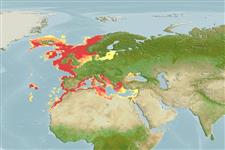
Eastern Atlantic: Norway and Iceland to Cape Blanc, West Africa; also the Mediterranean.
Lengte bij maturiteit / Grootte / Gewicht / Leeftijd
Maturiteit: Lm ?, range 20 - ? cm
Max length : 110 cm TL mannelijk / geslacht onbekend; (Ref. 1371); max. gepubliceerd gewicht: 3.5 kg (Ref. 40637); max. gerapporteerde leeftijd: 20 Jaren (Ref. 1371)
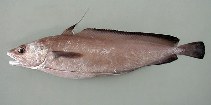
Dorsale stekels (totaal) : 0; Anale stekels: 0. Pelvic fin rays extremely elongated, reaching well beyond the origin of the anal fin. First dorsal fin with an elongate ray. Body color is brown to red-gray dorsally, becoming paler ventrally.
Body shape (shape guide): fusiform / normal; Cross section: oval.
Depth range from 10-800 m (Ref. 1371) and from 300-1047 m in the eastern Ionian Sea (Ref. 56504). Found over sand and mud bottoms (Ref. 1371). Young more coastal and found on the continental shelf while adults migrate along the slope (Ref. 1371). Feed mainly on crustaceans and fishes (Ref. 1371). Commonly less than 45 cm TL (Ref. 1371). Marketed fresh, also as fillets and fishmeal (Ref. 1371).
Cohen, D.M., T. Inada, T. Iwamoto and N. Scialabba, 1990. FAO species catalogue. Vol. 10. Gadiform fishes of the world (Order Gadiformes). An annotated and illustrated catalogue of cods, hakes, grenadiers and other gadiform fishes known to date. FAO Fish. Synop. 125(10). Rome: FAO. 442 p. (Ref. 1371)
Status op de Rode Lijst van het IUCN (Ref. 130435: Version 2025-2 (Global))
Gevaar voor de mens
Harmless
Gebruik door de mens
Visserij: commercieel
Tools
Speciale rapporten
Download XML
Internetbronnen
Schattingen op basis van modellen
Gewenste temperatuur (Ref.
123201): 5.4 - 14.6, mean 9.1 °C (based on 672 cells).
Fylogenetische diversiteitsindex (Ref.
82804): PD
50 = 0.6255 [Uniqueness, from 0.5 = low to 2.0 = high].
Bayesian length-weight: a=0.00457 (0.00384 - 0.00544), b=3.14 (3.09 - 3.19), in cm total length, based on LWR estimates for this species (Ref.
93245).
Trofisch niveau (Ref.
69278): 3.7 ±0.66 se; based on food items.
Weerstandsvermogen (Ref.
120179): Gemiddeld, minimale populatieverdubbelingstijd 1,4-4,4 jaar (K=0.21; tmax=20).
Prior r = 0.55, 95% CL = 0.36 - 0.83, Based on 2 full stock assessments.
Kwetsbaarheid van de visserij (Ref.
59153): Moderate to high vulnerability (52 of 100).
🛈
Kwetsbaarheid voor het klimaat (Ref.
125649): Moderate vulnerability (38 of 100).
🛈
Voedingsstoffen (Ref.
124155): Calcium = 14.3 [7.7, 26.9] mg/100g; Iron = 0.251 [0.143, 0.429] mg/100g; Protein = 17.5 [16.2, 18.8] %; Omega3 = 0.607 [0.312, 1.129] g/100g; Selenium = 30 [15, 57] μg/100g; VitaminA = 10.7 [3.1, 36.9] μg/100g; Zinc = 0.415 [0.291, 0.603] mg/100g (wet weight);