>
Gadiformes (Cods) >
Gadidae (Cods and haddocks)
Etymology: Pollachius: Scottish dialect, podlock, paddle = bumpfish (Ref. 45335).
More on author: Linnaeus.
Περιβάλλον: περιβάλλον / κλιματική ζώνη / εύρος βάθους / εύρος διανομής
Οικολογία
Θαλασσινό(ά) βενθικό(ς); ωκεανόδρομο(ς) (Ref. 51243); εύρος βάθους 37 - 364 m (Ref. 5951). Temperate; 77°N - 33°N, 76°W - 35°E
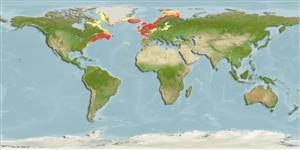
Eastern Atlantic: Barents Sea, Spitsbergen to Bay of Biscay, around Iceland. Western Atlantic: southwest Greenland, Hudson Strait to North Carolina, although rare at the extremes of the range. Migrations for spawning are known to occur. Also long-distance north-south migrations for Europe and the US.
Μήκος κατά την πρώτη ωρίμανση / Μέγεθος / Βάρος / Ηλικία
Γεννητική Ωρίμανση: Lm 39.1 range ? - ? cm
Max length : 130 cm TL αρσενικό/απροσδιόριστο; (Ref. 1371); common length : 60.0 cm TL αρσενικό/απροσδιόριστο; (Ref. 4645); μεγ. δημοσιευμένο βάρος: 32.0 kg (Ref. 7251); μεγ. αναφερόμενη ηλικία: 25 έτη (Ref. 1371)
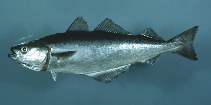
Ραχιαίες άκανθες (συνολικά) : 0; Εδρικές άκανθες: 0. Chin barbel small. Lateral line smooth along its entire length. Body color is brownish-green dorsally, becoming only slightly paler ventrally. The lateral line pale.
Body shape (shape guide): fusiform / normal; Cross section: circular.
An active, gregarious fish occurring inshore and offshore waters. Usually enters coastal waters in spring and returns to deeper waters in winter (Ref. 9988). Smaller fish in inshore waters feed on small crustaceans (copepods, amphipods, euphausiids) and small fish, while larger fish prey predominantly upon fishes. Spawn in batches (Ref. 51846). Utilized fresh, dried or salted, smoked, canned and frozen; eaten steamed, fried, broiled, boiled, microwaved and baked (Ref. 9988).
Oviparous, sexes are separate (Ref. 205).
Cohen, D.M., T. Inada, T. Iwamoto and N. Scialabba, 1990. FAO species catalogue. Vol. 10. Gadiform fishes of the world (Order Gadiformes). An annotated and illustrated catalogue of cods, hakes, grenadiers and other gadiform fishes known to date. FAO Fish. Synop. 125(10). Rome: FAO. 442 p. (Ref. 1371)
Κατάσταση Κόκκινου Καταλόγου IUCN (Ref. 130435: Version 2025-2 (Global))
Απειλή για τον άνθρωπο
Harmless
Ανθρώπινες χρήσεις
αλιεία: πολύ εμπορικό; αλιεία αναψυχής: ναί
Εργαλεία
Ειδικές εκθέσεις
Λήψη XML
Διαδικτυακές πηγές
Εκτιμήσεις βάσει μοντέλων
Προτιμώμενη θερμοκρασία (Αναφ.
123201): 0.5 - 10.2, mean 7 °C (based on 292 cells).
Δείκτης φυλογενετικής ποικιλότητας (Αναφ.
82804): PD
50 = 0.7500 [Uniqueness, from 0.5 = low to 2.0 = high].
Bayesian length-weight: a=0.00661 (0.00581 - 0.00752), b=3.07 (3.03 - 3.11), in cm total length, based on LWR estimates for this species (Ref.
93245).
Τροφικό Επίπεδο (Αναφ.
69278): 4.3 ±0.4 se; based on diet studies.
Generation time: 7.3 (5.6 - 9.2) years. Estimated as median ln(3)/K based on 12
growth studies.
Ελαστικότητα (Αναφ.
120179): Μεσαίο(α), ελάχιστος χρόνος για διπλασιασμό πληθυσμού 1,4 - 4,4 έτη (rm=0.55-0.87; K=0.07-0.17; tm=2-10; tmax=25; Fec=220,000).
Prior r = 0.52, 95% CL = 0.34 - 0.78, Based on 21 full stock assessments.
Ευπάθεια στην αλιεία (Ref.
59153): High vulnerability (59 of 100).
🛈
Ευπάθεια στο κλίμα (Ref.
125649): Moderate vulnerability (38 of 100).
🛈
Θρεπτικά συστατικά (Ref.
124155): Calcium = 11.7 [5.3, 40.2] mg/100g; Iron = 0.293 [0.115, 0.731] mg/100g; Protein = 18.3 [16.2, 20.3] %; Omega3 = 0.599 [0.310, 1.230] g/100g; Selenium = 27.1 [9.3, 77.1] μg/100g; VitaminA = 11.1 [2.8, 45.1] μg/100g; Zinc = 0.363 [0.184, 0.685] mg/100g (wet weight); based on
nutrient studies.