>
Clupeiformes (Herrings) >
Clupeidae (Herrings, shads, sardines, menhadens)
Etymology: Sprattus: Old German, sprotte (1611) = a small fish, Clupea sp. (Ref. 45335).
More on author: Linnaeus.
Taxonomic Remarks
The subspecies were not characterized well enough, that unless there is more evidence presented in the future, Sprattus sprattus should be considered as one species with several known populations (S.Kullander, pers.comm. 07/09).
Ambiente: milieu / zona climática / intervalo de profundidade / gama de distribuição
Ecologia
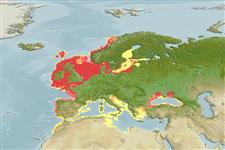
marinhas; estuarina pelagic-neritic; oceanódromo (Ref. 51243); intervalo de profundidade 10 - 150 m (Ref. 6302). Temperate; 69°N - 30°N, 11°W - 42°E
Northeast Atlantic: North Sea and adjacent waters as far north as the Lofoten Area and the west of the British Isles, and Baltic Sea south to Morocco; also in northern Mediterranean (Gulf of Lion and the Adriatic Sea) and Black Sea.
Comprimento na primeira maturidade / Tamanho / Peso / Idade
Maturidade: Lm 10.1, range 8 - 12 cm
Max length : 25.1 cm SL macho/indeterminado; (Ref. 137577); common length : 12.0 cm SL macho/indeterminado; (Ref. 188); Idade máx. registada: 6 anos (Ref. 3561)
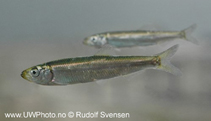
Espinhos dorsais (total) : 0; Raios dorsais moles (total) : 13 - 21; Espinhos anais: 0; Raios anais moles: 12 - 23. Lower jaw slightly projecting, gill cover without any bony radiating striae, teeth rarely present on vomer; belly with a strong keel of scutes; last two anal fin rays not enlarged. No dark spots on flanks. Pterotic bulla absent.
Body shape (shape guide): fusiform / normal; Cross section: compressed.
Usually inshore schooling, sometimes entering estuaries (especially the juveniles) and tolerating salinities as low as 4 ppt. Shows strong migrations between winter feeding and summer spawning grounds. Moves to the surface at night. Feeds on planktonic crustaceans (Ref. 9900). Spawns at depths of 10-20 m producing 6,000-14,000 pelagic eggs (Ref. 35388). Some spawn almost throughout the year, mainly in spring and summer, near the coast or up to 100 km out to sea, the young drifting inshore. Sold as 'brislings' to canneries. Sprat are used in the production of fish meal and as mink food, less for human consumption (Ref. 9900). Utilized fresh, smoked, canned and frozen; can be pan-fried and broiled (Ref. 9988).
Some spawn almost year round but mainly in spring and summer, near to the coast or up to 100 km out to sea, the young drifting inshore. Individual period of spawning takes about two months (Ref. 92054).
Whitehead, P.J.P., 1985. FAO Species Catalogue. Vol. 7. Clupeoid fishes of the world (suborder Clupeoidei). An annotated and illustrated catalogue of the herrings, sardines, pilchards, sprats, shads, anchovies and wolf-herrings. FAO Fish. Synop. 125(7/1):1-303. Rome: FAO. (Ref. 188)
Categoria na Lista Vermelha da IUCN (Ref. 130435: Version 2025-2 (Global))
Ameaça para o homem
Reports of ciguatera poisoning (Ref. 30911)
Utilização humana
Pescarias: altamente comercial; isco: usually
Ferramentas
Relatórios especiais
Descarregue XML
Fontes da internet
Estimativas baseadas em modelos
Temperatura preferida (Ref.
123201): 4.3 - 15.3, mean 9.5 °C (based on 530 cells).
Índice de diversidade filogenética (Ref.
82804): PD
50 = 0.5313 [Uniqueness, from 0.5 = low to 2.0 = high].
Bayesian length-weight: a=0.00550 (0.00468 - 0.00645), b=3.10 (3.05 - 3.15), in cm total length, based on LWR estimates for this species (Ref.
93245).
Nível Trófico (Ref.
69278): 3.0 ±0.07 se; based on food items.
Generation time: 2.2 (1.7 - 2.7) years. Estimated as median ln(3)/K based on 24
growth studies.
Resiliência (Ref.
120179): Médio, tempo mínimo de duplicação da população 1,4 - 4,4 anos (rm=1.7; K=0.14-0.77; tm=1-2; tmax=6; Fec=2,000 (batch fec)).
Prior r = 0.48, 95% CL = 0.32 - 0.72, Based on 17 full stock assessments.
Vulnerabilidade da pesca (Ref.
59153): Low to moderate vulnerability (34 of 100).
🛈
Vulnerabilidade climática (Ref.
125649): Low vulnerability (15 of 100).
🛈
Nutrientes (Ref.
124155): Calcium = 69.8 [34.7, 136.5] mg/100g; Iron = 0.454 [0.171, 1.290] mg/100g; Protein = 19.9 [17.2, 22.6] %; Omega3 = 0.601 [0.328, 1.136] g/100g; Selenium = 8.55 [3.88, 18.40] μg/100g; VitaminA = 66.3 [13.8, 248.5] μg/100g; Zinc = 0.429 [0.200, 1.835] mg/100g (wet weight); based on
nutrient studies.