>
Ophidiiformes (Cusk eels) >
Ophidiidae (Cusk-eels) > Ophidiinae
Etymology: Lepophidium: Latin, lepus, leporis = rabbit + Greek, ophis = serpent (Ref. 45335).
More on author: Gilbert.
Ambiente: milieu / zona climatica / distribuzione batimetrica / gamma di distribuzione
Ecologia
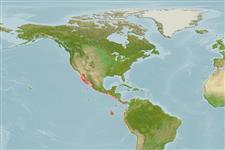
marino demersale; distribuzione batimetrica 73 - 307 m (Ref. 91765). Subtropical; 30°N - 21°N, 118°W - 108°W (Ref. 91765)
Eastern Pacific: Gulf of California and along the outer coast of Baja California as far north as Bahía Sebastían Viscaíno.
Dimensione / Peso / Età
Maturità: Lm ? range ? - ? cm
Max length : 41.5 cm TL maschio/sesso non determinato; (Ref. 86316)
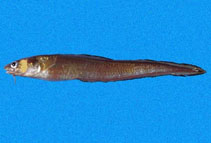
Raggi dorsali molli (totale) : 117 - 128; Raggi anali molli: 97 - 108; Vertebre: 66 - 70. This fine-scaled species have the following characteristics: pyloric caeca usually 5-6, typically 5 + 1; usually 3 rudimentary gill rakers on the upper arm of the first arch and 4-5 developed rakers on lower arm with 2-5 rudimentary rakers anteriorly, total gill rakers usually 11-12 (10-15); count of scale rows almost 30 between the occipital line and the dorsal-fin origin, 14-15 rows between the dorsal-fin origin and the lateral line, and about 255 lateral scale rows; dorsal-fin origin between neural spines 4-5 (rarely between 3-4); color of head and body rather uniformly dusky, silvery, or whitish along the belly; dorsal fin usually lacks a dark edge, and when present it is poorly developed; anal fin has an inconspicuous and narrow dark edge; orobranchial cavity usually pale, but the rear of the roof of the mouth may be dusky; esophagus blackish; stomach and hindgut pale (Ref. 91765).
Body shape (shape guide): elongated; Cross section: compressed.
Occurs benthically, from 210-307 m in the Gulf of California and 73-293 m on the outer coast (Ref. 91765). Oviparous, with oval pelagic eggs floating in a gelatinous mass (Ref. 205).
Ciclo vitale e comportamento di accoppiamento
Maturità | Riproduzione | Deposizione | Uova | Fecondità | Larve
Robins, C.R., R.H. Robins and M.E. Brown, 2012. A revision of Lepophidium (Teleoastei, Ophidiidae), with descriptions of eight new species. Bulletin of the Florida Museum of Natural History 52(1):1-94. (Ref. 91765)
Stato della Lista Rossa IUCN (Ref. 130435: Version 2025-2 (Global))
Minaccia per l'uomo
Harmless
Usi umani
Strumenti
Rapporti speciali
Scarica XML
Fonti Internet
Stime basate su modelli
Temperatura preferita (Fonte Biblio.
123201): 12.1 - 15.6, mean 14 °C (based on 46 cells).
Indice di diversità filogenetica (Fonte Biblio.
82804): PD
50 = 0.5000 [Uniqueness, from 0.5 = low to 2.0 = high].
Bayesian length-weight: a=0.00224 (0.00122 - 0.00410), b=3.15 (2.99 - 3.31), in cm total length, based on LWR estimates for this species & Genus-body shape (Ref.
93245).
Livello trofico (Fonte Biblio.
69278): 3.7 ±0.7 se; based on size and trophs of closest relatives
Resilienza (Fonte Biblio.
120179): Medio, tempo minimo di raddoppiamento della popolazione 1.4 - 4.4 anni (Preliminary K or Fecundity.).
Vulnerabilità della pesca (Ref.
59153): Low to moderate vulnerability (32 of 100).
🛈