Umwelt: Milieu / Klimazone / Tiefenbereich / Verbreitungsgebiet
Ökologie
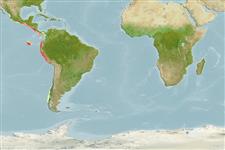
seewasser demersal; tiefenbereich 35 - 600 m (Ref. 82251), usually 251 - 300 m (Ref. 82251). Subtropical; 24°N - 47°S, 107°W - 74°W
Eastern Pacific: distribution is not precisely known; but may extend from Mazatlán, Mexico to Chile.
Größe / Gewicht / Alter
Geschlechtsreife: Lm ? range ? - ? cm
Common length : 35.0 cm TL Männchen/unbestimmt; (Ref. 9330)
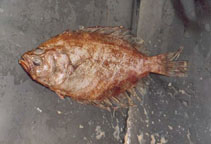
Rückenflossenstacheln (insgesamt) : 0; Rückenflossenweichstrahlen (insgesamt) : 64 - 73; Afterflossenstacheln: 0; Afterflossenweichstrahlen: 52 - 58. Pectoral fins rather small, about 2 times in head in ocular side and about 2.5 times in head on blind side. Pelvic fin on ocular side slightly larger than on blind side. Caudal fin round. Body brownish, with obscure darker spots on body and fins (Ref. 27363).
Body shape (shape guide): short and / or deep.
This species inhabits soft bottoms (Ref. 9330); from the littoral zone (35 m, shallowest depth reported in Ref. 9330) up to 600 m (Yañez and Barbieri, 1974.in Ref. 82251:833). Common depth range was taken from a study done in northern Chile. Stomach contents include mainly the squat lobsters (Pleuroncodes monodon and Cervimunida johni) and the deep-sea shrimp (Heterocarpus reedi) (Ref. 82251). Exploited on a local level with trawl nets and is utilized fresh or as fishmeal.
Lebenszyklus und Paarungsverhalten
Geschlechtsreife | Fortpflanzung | Ablaichen | Eier | Fruchtbarkeit | Larven
Distinct pairing (Ref. 205).
Hensley, D.A., 1995. Paralichthyidae. Lenguados. p. 1349-1380. In W. Fischer, F. Krupp, W. Schneider, C. Sommer, K.E. Carpenter and V. Niem (eds.) Guia FAO para Identification de Especies para lo Fines de la Pesca. Pacifico Centro-Oriental. 3 Vols. FAO, Rome. (Ref. 9330)
IUCN Rote Liste Status (Ref. 130435: Version 2025-2 (Global))
Bedrohung für Menschen
Harmless
Nutzung durch Menschen
Fischereien: weniger kommerziell
Tools
Zusatzinformationen
Download XML
Internet Quellen
Schätzungen auf der Grundlage von Modellen
Bevorzugte Temperatur (Ref.
123201): 10.9 - 12, mean 11.4 °C (based on 7 cells).
Phylogenetischer Diversitätsindex (Ref.
82804): PD
50 = 0.5078 [Uniqueness, from 0.5 = low to 2.0 = high].
Bayesian length-weight: a=0.00724 (0.00346 - 0.01519), b=3.17 (3.00 - 3.34), in cm total length, based on LWR estimates for this (Sub)family-body shape (Ref.
93245).
Trophische Ebene (Ref.
69278): 3.7 ±0.3 se; based on diet studies.
Widerstandsfähigkeit (Ref.
120179): hoch, Verdopplung der Population dauert weniger als 15 Monate. (Preliminary K or Fecundity.).
Anfälligkeit der Fischerei (Ref.
59153): Low to moderate vulnerability (31 of 100).
🛈
Nährstoffe (Ref.
124155): Calcium = 461 [145, 1,393] mg/100g; Iron = 1.46 [0.59, 3.70] mg/100g; Protein = 16.2 [13.8, 18.5] %; Omega3 = 0.409 [0.142, 1.201] g/100g; Selenium = 14.4 [4.0, 51.4] μg/100g; VitaminA = 114 [18, 780] μg/100g; Zinc = 1.81 [0.93, 3.31] mg/100g (wet weight);