สิ่งแวดล้อม : สิ่งแวดล้อม / เขตภูมิอากาศ / ระดับความลึก / ระยะการกระจายสินค้า
นิเวศวิทยา
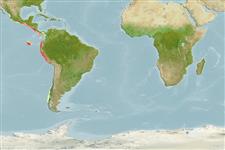
เกี่ยวกับทะเล,น้ำเค็ม สัตว์น้ำหน้าดิน; ระดับความลึก 35 - 600 m (Ref. 82251), usually 251 - 300 m (Ref. 82251). Subtropical; 24°N - 47°S, 107°W - 74°W
Eastern Pacific: distribution is not precisely known; but may extend from Mazatlán, Mexico to Chile.
ขนาด / น้ำหนัก / อายุ
วัยเจริญพันธุ์: Lm ? range ? - ? cm
Common length : 35.0 cm TL เพศผู้/กระเทย; (Ref. 9330)
คำอธิบายสั้นๆ
เครื่องมือที่ใช้ในการแยกชนิดสัตว์,สิ่งมีชีวิตออกจากกัน | สัณฐานวิทยา | ความยาวต่างๆ
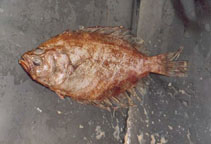
เงี่ยงครีบหลัง (รวม) : 0; ก้านครีบอ่อนที่หาง (รวม) : 64 - 73; เงี่ยงครีบก้น: 0; ก้านครีบอ่อนที่ก้น: 52 - 58. Pectoral fins rather small, about 2 times in head in ocular side and about 2.5 times in head on blind side. Pelvic fin on ocular side slightly larger than on blind side. Caudal fin round. Body brownish, with obscure darker spots on body and fins (Ref. 27363).
Body shape (shape guide): short and / or deep.
This species inhabits soft bottoms (Ref. 9330); from the littoral zone (35 m, shallowest depth reported in Ref. 9330) up to 600 m (Yañez and Barbieri, 1974.in Ref. 82251:833). Common depth range was taken from a study done in northern Chile. Stomach contents include mainly the squat lobsters (Pleuroncodes monodon and Cervimunida johni) and the deep-sea shrimp (Heterocarpus reedi) (Ref. 82251). Exploited on a local level with trawl nets and is utilized fresh or as fishmeal.
วงจรชีวิตและพฤติกรรมการผสมพันธุ์
วัยเจริญพันธุ์ | การสืบพันธุ์ | การวางไข่ | เซลสืบพันธ์ของเพศเมีย(ไข่) | ความดกของไข่ | ตัวอ่อน
Distinct pairing (Ref. 205).
Hensley, D.A., 1995. Paralichthyidae. Lenguados. p. 1349-1380. In W. Fischer, F. Krupp, W. Schneider, C. Sommer, K.E. Carpenter and V. Niem (eds.) Guia FAO para Identification de Especies para lo Fines de la Pesca. Pacifico Centro-Oriental. 3 Vols. FAO, Rome. (Ref. 9330)
สถานะบัญชีแดงของ IUCN (Ref. 130435: Version 2025-2 (Global))
ภัยคุกคามต่อมนุษย์
Harmless
การใช้ของมนุษย์
การประมง: มีการค้าเพียงเล็กน้อย
เครื่องมือ
รายงานพิเศษ
ดาวน์โหลด XML
แหล่งที่มาจากอินเตอร์เน็ต
การประมาณค่าตามแบบจำลอง
อุณหภูมิที่ต้องการ (อ้างอิง
123201): 10.9 - 12, mean 11.4 °C (based on 7 cells).
ดัชนีความหลากหลายทางวิวัฒนาการ (อ้างอิง
82804): PD
50 = 0.5078 [Uniqueness, from 0.5 = low to 2.0 = high].
Bayesian length-weight: a=0.00724 (0.00346 - 0.01519), b=3.17 (3.00 - 3.34), in cm total length, based on LWR estimates for this (Sub)family-body shape (Ref.
93245).
ระดับชั้นอาหาร (อ้างอิง
69278): 3.7 ±0.3 se; based on diet studies.
ความสามารถในการกลับคืนสู่ปกติ (อ้างอิง
120179): ความสูง, เวลาต่ำสุดที่จะทำให้ประชากรเพิ่มขึ้นเป็น 2 เท่าใช้เวลาน้อยกว่า 15 เดือน (Preliminary K or Fecundity.).
ความเสี่ยงต่อการตกปลา (Ref.
59153): Low to moderate vulnerability (31 of 100).
🛈
สารอาหาร (Ref.
124155): Calcium = 461 [145, 1,393] mg/100g; Iron = 1.46 [0.59, 3.70] mg/100g; Protein = 16.2 [13.8, 18.5] %; Omega3 = 0.409 [0.142, 1.201] g/100g; Selenium = 14.4 [4.0, 51.4] μg/100g; VitaminA = 114 [18, 780] μg/100g; Zinc = 1.81 [0.93, 3.31] mg/100g (wet weight);