>
Clupeiformes (Herrings) >
Spratelloididae (Small round herrings)
Etymology: Spratelloides: Old German, sprotte (1611) = a small fish, Clupea sp. + Greek, suffix, oides = similar to (Ref. 45335).
Eponymy: Dr Anthony David Lewis (d: 1948) is an Australian fisheries biologist and independent fisheries adviser who has joined the International Pole & Line Federation as a trustee (2014). [...] (Ref. 128868), visit book page.
Taxonomic Remarks
The species in the genera Spratelloides Bleeker, 1851 and Jenkinsia Jordan & Evermann, 1896 should most probably be assigned to a separated family from Clupeidae and Dussumieriidae (Lavoué, pers. comm., July 2013). See a preliminary analysis in Lavoué et al. (2013: Ref. 93878).
Milieu: milieu / Klimaatzone / Diepte / verspreidingsgebied
Ecologie
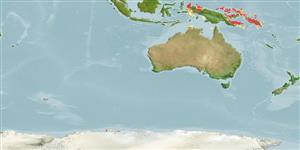
marien pelagic-neritic; diepte 0 - 50 m (Ref. 188). Tropical; 2°N - 12°S, 130°E - 164°E (Ref. 188)
Western Central Pacific: Solomon Islands, Papua New Guinea, and off Irian Jaya.
Grootte / Gewicht / Leeftijd
Maturiteit: Lm ? range ? - ? cm
Max length : 6.0 cm SL mannelijk / geslacht onbekend; (Ref. 188)
Dorsale stekels (totaal) : 0; Dorsale zachte stralen (totaal) : 12 - 13; Anale stekels: 0; Anale zachte stralen: 11 - 12. Distinguished from other species mainly by the silver band on the flanks which fades anteriorly (at about tips of pectoral fins). Maxilla toothed, triangular pre-maxillae, 2 supra-maxillae, second supra-maxilla asymmetrical (lower part larger than upper); vertical striae on scales not meeting at center; W-shaped pelvic scute.
Body shape (shape guide): fusiform / normal; Cross section: oval.
Usually an inshore schooling species. More data needed. Used as bait in the tuna fishery. Found in coastal waters, sometimes forming large active schools at surface near reefs (Ref 90102).
Levenscyclus en paargedrag
Maturiteit | Voortplanting | Paaien | Eieren | Fecunditeit | Larven
Whitehead, P.J.P., 1985. FAO Species Catalogue. Vol. 7. Clupeoid fishes of the world (suborder Clupeoidei). An annotated and illustrated catalogue of the herrings, sardines, pilchards, sprats, shads, anchovies and wolf-herrings. FAO Fish. Synop. 125(7/1):1-303. Rome: FAO. (Ref. 188)
Status op de Rode Lijst van het IUCN (Ref. 130435: Version 2025-2 (Global))
Gevaar voor de mens
Harmless
Gebruik door de mens
Visserij: visserij voor eigen gebruik; aas: usually
Tools
Speciale rapporten
Download XML
Internetbronnen
Schattingen op basis van modellen
Gewenste temperatuur (Ref.
123201): 28.2 - 29.1, mean 28.8 °C (based on 16 cells).
Fylogenetische diversiteitsindex (Ref.
82804): PD
50 = 0.5664 [Uniqueness, from 0.5 = low to 2.0 = high].
Bayesian length-weight: a=0.00513 (0.00293 - 0.00898), b=3.14 (2.99 - 3.29), in cm total length, based on LWR estimates for this species & (Sub)family-body (Ref.
93245).
Trofisch niveau (Ref.
69278): 3.0 ±0.0 se; based on diet studies.
Weerstandsvermogen (Ref.
120179): Hoog, minimale populatieverdubbelingstijd minder dan 15 maanden (K=4.30-8.90; tm=0.3; Fec=887).
Kwetsbaarheid van de visserij (Ref.
59153): Low vulnerability (10 of 100).
🛈
Voedingsstoffen (Ref.
124155): Calcium = 2530 [213, 133,283] mg/100g; Iron = 41.7 [3.8, 409.3] mg/100g; Protein = 18.8 [14.4, 23.1] %; Omega3 = 0.227 [0.004, 13.207] g/100g; Selenium = 1810 [23, 107,595] μg/100g; VitaminA = 0.46 [0.00, 53.86] μg/100g; Zinc = 33.4 [4.1, 187.8] mg/100g (wet weight);