>
Ovalentaria/misc (Various families in series Ovalentaria) >
Plesiopidae (Roundheads) > Plesiopinae
Etymology: Plesiops: Greek, plesios = near + Greek, ops = appearance (Ref. 45335); corallicola: Specific epithet refers to the habitat of the species, a coral-dweller (Ref. 27772).
More on author: Bleeker.
Umwelt: Milieu / Klimazone / Tiefenbereich / Verbreitungsgebiet
Ökologie
seewasser riff-verbunden; tiefenbereich 1 - 23 m (Ref. 9710), usually 1 - 10 m (Ref. 27115). Tropical; 23°C - 27°C (Ref. 130634); 32°N - 24°S
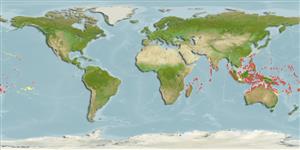
Indo-Pacific: Madagascar to the Line Islands; north to southern Japan, south to the southern Great Barrier Reef and Tonga. Throughout Micronesia.
Größe / Gewicht / Alter
Geschlechtsreife: Lm ? range ? - ? cm
Max length : 18.0 cm TL Männchen/unbestimmt; (Ref. 90102)
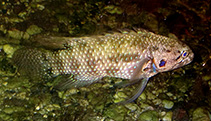
Rückenflossenstacheln (insgesamt) : 12; Rückenflossenweichstrahlen (insgesamt) : 7 - 8; Afterflossenstacheln: 3; Afterflossenweichstrahlen: 8. Coloration can vary from pale gray with black blotches and blue dots to an almost uniformly black except for the ever-present blue ocellus on the edge of its operculum.
Body shape (shape guide): elongated; Cross section: compressed.
Adults are benthic which occur inshore (Ref. 7300). Relatively common on reef flats, searching under rocks or in crevices for small fishes and crustaceans which serve as food (Ref. 1602). Common, but hidden in holes by day. They venture out to feed on small invertebrates and fishes at night (Ref. 9710). Apparently, gastropods form an important component of the diet as indicated by X-ray radiographs (Ref. 27772). Eggs are guarded by the male parent (Ref. 205). Aquarium breeding is possible (Ref. 130634). Minimum depth reported from Ref. 27115.
Lebenszyklus und Paarungsverhalten
Geschlechtsreife | Fortpflanzung | Ablaichen | Eier | Fruchtbarkeit | Larven
Eggs are guarded by the male parent (Ref. 205).
Mooi, R.D., 1995. Revision, phylogeny, and discussion of biology and biogeography of the fish genus Plesiops (Perciformes: Plesiopsidae). Life Sci. Contrib. No. 159, 108 p. (Ref. 27772)
IUCN Rote Liste Status (Ref. 130435: Version 2025-2 (Global))
Bedrohung für Menschen
Harmless
Nutzung durch Menschen
Fischereien: kommerziell; Aquarium: Kommerziell
Tools
Zusatzinformationen
Download XML
Internet Quellen
Schätzungen auf der Grundlage von Modellen
Bevorzugte Temperatur (Ref.
123201): 26.3 - 29.3, mean 28.6 °C (based on 2693 cells).
Phylogenetischer Diversitätsindex (Ref.
82804): PD
50 = 0.5000 [Uniqueness, from 0.5 = low to 2.0 = high].
Bayesian length-weight: a=0.00468 (0.00172 - 0.01274), b=3.18 (2.95 - 3.41), in cm total length, based on LWR estimates for this (Sub)family-body shape (Ref.
93245).
Trophische Ebene (Ref.
69278): 3.7 ±0.58 se; based on food items.
Widerstandsfähigkeit (Ref.
120179): mittel, Verdopplung der Population dauert 1,4 - 4,4 Jahre. (Preliminary K or Fecundity.).
Anfälligkeit der Fischerei (Ref.
59153): Low vulnerability (10 of 100).
🛈
Nährstoffe (Ref.
124155): Calcium = 86.8 [46.0, 136.3] mg/100g; Iron = 0.604 [0.370, 0.980] mg/100g; Protein = 18.6 [17.5, 19.6] %; Omega3 = 0.0952 [, ] g/100g; Selenium = 24.7 [12.4, 48.8] μg/100g; VitaminA = 131 [46, 357] μg/100g; Zinc = 1.5 [1.0, 2.1] mg/100g (wet weight);