>
Clupeiformes (Herrings) >
Dorosomatidae (Gizzard shads and sardinellas)
Etymology: Sardinella: Latin and Greek, sarda = sardine; name related to the island of Sardinia; diminutive (Ref. 45335).
More on author: Bleeker.
Môi trường: môi trường / vùng khí hậu / Mức độ sâu / phạm vi phân phối
Sinh thái học
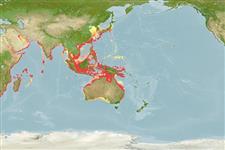
biển pelagic-neritic; mức độ sâu 10 - 70 m (Ref. 12260). Tropical; 41°N - 37°S, 19°E - 155°E
Indo-West Pacific: widespread including the Red Sea, and reported as an invasive species in the eastern Mediterranean basin.
Chiều dài lúc trưởng thành đầu tiên / Bộ gần gũi / Khối lượng (Trọng lượng) / Tuổi
Chín muồi sinh dục: Lm 13.3, range 10 - ? cm
Max length : 29.6 cm TL con đực/không giới tính; (Ref. 116943); common length : 15.0 cm SL con đực/không giới tính; (Ref. 188); Tuổi cực đại được báo cáo: 7 các năm (Ref. 1488)
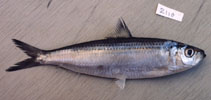
Các tia vây lưng cứng (tổng cộng) : 0; Các vây lưng mềm (tổng cộng) : 13 - 21; Tia cứng vây hậu môn: 0; Tia mềm vây hậu môn: 12 - 23. Total number scutes 32 to 34. Vertical striae on scales not meeting at center, numerous small perforations on hind part of scale. A golden mid-lateral line down flank; dorsal and caudal fin margins dusky; a dark spot at dorsal fin origin. Lower gill rakers 45 to 59 (at 6 to 17 cm standard length, not increasing with size of fish after 6 cm standard length).
Body shape (shape guide): fusiform / normal; Cross section: compressed.
Forms schools in coastal waters. Adults feed on phytoplankton and zooplankton (crustacean and molluscan larvae) (Ref. 5213, 5284). Juveniles predominantly prefer crustaceans expanding to include phytoplankton in the diet as their length increases (Ref. 34224). Marketed fresh, dried-salted, boiled or made into fish balls. Possible or even probable confusion with other species (especially S. fimbriata in Indian waters) makes published biological data potentially unreliable.
Stern, N., B. Rinkevich and M. Goren, 2016. Integrative approach revises the frequently misidentified species of Sardinella (Clupeidae) of the Indo-West Pacific Ocean. J. Fish Biol. 89(5):2282-2305. (Ref. 114969)
Tình trạng Sách đỏ IUCN (Ref. 130435: Version 2025-2 (Global))
Mối đe dọa đối với con người
Harmless
Sử dụng của con người
Các nghề cá: tính thương mại cao
Các công cụ
Báo cáo đặc biệt
Tải xuống XML
Các nguồn internet
Ước tính dựa trên mô hình
Nhiệt độ ưa thích (Tài liệu tham khảo
123201): 23.6 - 29.1, mean 28.1 °C (based on 1384 cells).
Chỉ số đa dạng phát sinh loài (Tài liệu tham khảo
82804): PD
50 = 0.5000 [Uniqueness, from 0.5 = low to 2.0 = high].
Bayesian length-weight: a=0.00813 (0.00670 - 0.00986), b=3.04 (3.01 - 3.07), in cm total length, based on LWR estimates for this species (Ref.
93245).
Mức dinh dưỡng (Tài liệu tham khảo
69278): 2.9 ±0.30 se; based on food items.
Generation time: 1.1 (0.8 - 2.6) years. Estimated as median ln(3)/K based on 13
growth studies.
Thích nghi nhanh (Tài liệu tham khảo
120179): Chiêù cao, thời gian nhân đôi của chủng quần tối thiểu là dưới 15 tháng (K=0.32-1.8; tmax=7).
Prior r = 1.07, 95% CL = 0.71 - 1.60, Based on 4 data-limited stock assessments.
Sự dễ bị tổn thương của nghề đánh cá (Ref.
59153): Low vulnerability (19 of 100).
🛈
Sự dễ bị tổn thương của khí hậu (Ref.
125649): Moderate to high vulnerability (47 of 100).
🛈
Chất dinh dưỡng (Ref.
124155): Calcium = 252 [134, 390] mg/100g; Iron = 2.14 [1.25, 3.86] mg/100g; Protein = 20.6 [19.6, 21.6] %; Omega3 = 0.281 [0.140, 0.540] g/100g; Selenium = 127 [68, 257] μg/100g; VitaminA = 15.3 [5.1, 45.0] μg/100g; Zinc = 1.16 [0.84, 1.63] mg/100g (wet weight); based on
nutrient studies.