Milieu: milieu / Klimaatzone / Diepte / verspreidingsgebied
Ecologie
; zoet water demersaal; potamodroom (Ref. 51243). Tropical
Southeast Asia: endemic to the Mekong River (Cambodia and Thailand); introduced to Chao Phraya River (Thailand).
Grootte / Gewicht / Leeftijd
Maturiteit: Lm ? range ? - ? cm
Max length : 62.0 cm WD mannelijk / geslacht onbekend; (Ref. 27732); max. gepubliceerd gewicht: 6.0 kg (Ref. 27732)
Korte beschrijving
Determinatiesleutels | Morfologie | Morfometrie
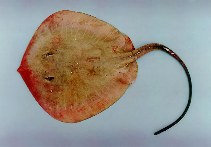
Dorsale stekels (totaal) : 0; Anale stekels: 0. Distinguished from the other stingray species in the Mekong basin by the presence of a ventral and a dorsal skin folds on the tail and the bright orange color of the ventral surface of the disc. The middle disc is whitish with scattered large orange spots. The dorsal surface of the disc is brown (Ref. 27732). Disc longer than wide; tail longer than body (Ref. 12693). Lacking caudal fin; with long whip-like tail (Ref. 43281).
Body shape (shape guide): other.
Obligate freshwater stingray that occurs over sandy substrate in large rivers. Feeds on bottom-dwelling invertebrates (Ref. 12693). Ovoviviparous (Ref. 50449). Marketed fresh (Ref. 32457).
Levenscyclus en paargedrag
Maturiteit | Voortplanting | Paaien | Eieren | Fecunditeit | Larven
Exhibit ovoviparity (aplacental viviparity), with embryos feeding initially on yolk, then receiving additional nourishment from the mother by indirect absorption of uterine fluid enriched with mucus, fat or protein through specialised structures (Ref. 50449). Distinct pairing with embrace (Ref. 205).
Last, P.R. and L.J.V. Compagno, 1999. Dasyatididae. Stingrays. p. 1479-1505. In K.E. Carpenter and V.H. Niem (eds.) FAO species identification guide for fishery purposes. The living marine resources of the Western Central Pacific. Vol. 3. Batoid fishes, chimaeras and bony fishes part 1 (Elopidae to Linophrynidae). FAO, Rome. (Ref. 9840)
Status op de Rode Lijst van het IUCN (Ref. 130435: Version 2025-2 (Global))
Gevaar voor de mens
Harmless
Gebruik door de mens
Visserij: van minder commercieel belang
Tools
Speciale rapporten
Download XML
Internetbronnen
Schattingen op basis van modellen
Fylogenetische diversiteitsindex (Ref.
82804): PD
50 = 0.5005 [Uniqueness, from 0.5 = low to 2.0 = high].
Bayesian length-weight: a=0.00447 (0.00189 - 0.01058), b=3.12 (2.92 - 3.32), in cm total length, based on LWR estimates for this (Sub)family-body shape (Ref.
93245).
Trofisch niveau (Ref.
69278): 3.5 ±0.37 se; based on food items.
Weerstandsvermogen (Ref.
120179): Zeer laag, minimale populatieverdubbelingstijd meer dan 14 jaar (Assuming Fec<10).
Kwetsbaarheid van de visserij (Ref.
59153): Very high vulnerability (90 of 100).
🛈