Classification / Noms
Noms communs | Synonymes | Catalog of Fishes(Genre, Espèce) | ITIS | CoL | WoRMS | Cloffa
Environnement : milieu / zone climatique / profondeur / gamme de distribution
Écologie
; eau douce démersal; potamodrome (Ref. 51243). Tropical
Southeast Asia: endemic to the Mekong River (Cambodia and Thailand); introduced to Chao Phraya River (Thailand).
Taille / Poids / Âge
Maturité: Lm ? range ? - ? cm
Max length : 62.0 cm WD mâle / non sexé; (Ref. 27732); poids max. publié: 6.0 kg (Ref. 27732)
Description synthétique
Clés d'identification | Morphologie | Morphométrie
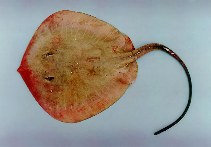
Épines dorsales (Total) : 0; Épines anales: 0. Distinguished from the other stingray species in the Mekong basin by the presence of a ventral and a dorsal skin folds on the tail and the bright orange color of the ventral surface of the disc. The middle disc is whitish with scattered large orange spots. The dorsal surface of the disc is brown (Ref. 27732). Disc longer than wide; tail longer than body (Ref. 12693). Lacking caudal fin; with long whip-like tail (Ref. 43281).
Body shape (shape guide): other.
Obligate freshwater stingray that occurs over sandy substrate in large rivers. Feeds on bottom-dwelling invertebrates (Ref. 12693). Ovoviviparous (Ref. 50449). Marketed fresh (Ref. 32457).
Cycle de vie et comportement reproducteur
Maturité | Reproduction | Frai | Œufs | Fécondité | Larves
Exhibit ovoviparity (aplacental viviparity), with embryos feeding initially on yolk, then receiving additional nourishment from the mother by indirect absorption of uterine fluid enriched with mucus, fat or protein through specialised structures (Ref. 50449). Distinct pairing with embrace (Ref. 205).
Last, P.R. and L.J.V. Compagno, 1999. Dasyatididae. Stingrays. p. 1479-1505. In K.E. Carpenter and V.H. Niem (eds.) FAO species identification guide for fishery purposes. The living marine resources of the Western Central Pacific. Vol. 3. Batoid fishes, chimaeras and bony fishes part 1 (Elopidae to Linophrynidae). FAO, Rome. (Ref. 9840)
Statut dans la liste rouge de l'IUCN (Ref. 130435: Version 2025-2 (Global))
Menace pour l'homme
Harmless
Utilisations par l'homme
Pêcheries: intérêt commercial mineur
Outils
Articles particuliers
Télécharger en XML
Sources Internet
Estimations basées sur des modèles
Indice de diversité phylogénétique (Réf.
82804): PD
50 = 0.5005 [Uniqueness, from 0.5 = low to 2.0 = high].
Bayesian length-weight: a=0.00447 (0.00189 - 0.01058), b=3.12 (2.92 - 3.32), in cm total length, based on LWR estimates for this (Sub)family-body shape (Ref.
93245).
Niveau trophique (Réf.
69278): 3.5 ±0.37 se; based on food items.
Résilience (Réf.
120179): Très faible, temps minimum de doublement de population supérieur à 14 ans (Assuming Fec<10).
Vulnérabilité de la pêche (Ref.
59153): Very high vulnerability (90 of 100).
🛈