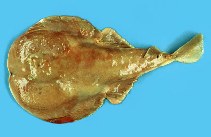
Ambiente: milieu / zona climatica / distribuzione batimetrica / gamma di distribuzione
Ecologia
marino associati a barriera corallina; distribuzione batimetrica 100 - ? m (Ref. 114953). Subtropical; 37°N - 20°N, 114°E - 139°E (Ref. 114953)
Northwest Pacific: southern Japan to the South China Sea near Hong Kong, including Taiwan.
Lunghezza alla prima maturità / Dimensione / Peso / Età
Maturità: Lm ?, range 35 - ? cm
Max length : 40.0 cm TL maschio/sesso non determinato; (Ref. 12951)
Occurs inshore and offshore (Ref. 9913, 11230). Found on sand, often near rocky reefs (Ref. 12951). Biology little known (Ref. 9913), but locally common in Taiwan and Japan (Ref. 114953). Produces 4-6 pups per litter. Maturity size of males known at 25 cm TL. Not utilized for food. Capable of producing a moderate shock to humans (Ref. 114953). Does not do well in aquariums (Ref. 12951).
Ciclo vitale e comportamento di accoppiamento
Maturità | Riproduzione | Deposizione | Uova | Fecondità | Larve
Ovoviviparous. Up to 5 in a litter (Ref. 12951).
Compagno, L.J.V. and P.R. Last, 1999. Narkidae. Sleeper rays. p. 1443-1446. In K.E. Carpenter and V.H. Niem (eds.) FAO identification guide for fishery purposes. The living marine resources of the Western Central Pacific. FAO, Rome. (Ref. 9913)
Stato della Lista Rossa IUCN (Ref. 130435: Version 2025-2 (Global))
Usi umani
Pesca: scarso interesse commerciale
Strumenti
Rapporti speciali
Scarica XML
Fonti Internet
Stime basate su modelli
Temperatura preferita (Fonte Biblio.
123201): 18.5 - 28.9, mean 26.8 °C (based on 559 cells).
Indice di diversità filogenetica (Fonte Biblio.
82804): PD
50 = 0.6252 [Uniqueness, from 0.5 = low to 2.0 = high].
Bayesian length-weight: a=0.01000 (0.00244 - 0.04107), b=3.04 (2.81 - 3.27), in cm total length, based on all LWR estimates for this body shape (Ref.
93245).
Livello trofico (Fonte Biblio.
69278): 3.5 ±0.37 se; based on food items.
Resilienza (Fonte Biblio.
120179): Basso, tempo minimo di raddoppiamento della popolazione 4.5 - 14 anni (Assuming fecundity<100).
Vulnerabilità della pesca (Ref.
59153): Low to moderate vulnerability (30 of 100).
🛈