>
Clupeiformes (Herrings) >
Alosidae (Shads and Sardines)
Etymology: Brevoortia: From James Carson Brevoort (1818-1887), studie the fauna from Ohio and South Caroline (Ref. 45335).
Eponymy: James Carson Brevoort (1818–1887) was an American collector of coins and rare books. [...] (Ref. 128868), visit book page.
More on authors: Spix & Agassiz.
Environnement : milieu / zone climatique / profondeur / gamme de distribution
Écologie
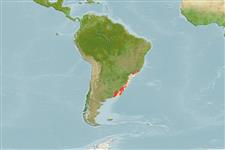
marin pelagic-neritic. Subtropical; 22°S - 38°S, 60°W - 42°W (Ref. 188)
Southwest Atlantic: Rio de Janeiro, Brazil probably to mouth of Rio de la Plata, Argentina (needs confirmation).
Taille / Poids / Âge
Maturité: Lm ? range ? - ? cm
Max length : 34.4 cm TL mâle / non sexé; (Ref. 111977)
Description synthétique
Clés d'identification | Morphologie | Morphométrie
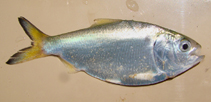
Épines dorsales (Total) : 0; Épines anales: 0. Scutes apparent along belly. Upper jaw with distinct median notch. Pectoral fin tip short of pelvic fin base by width of 3 to 7 scales; pelvic fin with oblique and almost straight hind margin. Pre-dorsal scales modified; scales on back and above base of anal fin not markedly smaller than rest. A black spot behind gill opening, but none along flank.
Body shape (shape guide): elongated; Cross section: compressed.
Forms schools (Ref. 188). The morphological characteristics observed and the composition of the trophic spectrum indicate that this species is a filter-feeder, consuming mainly phytoplankton (Ref. 34154).
Cycle de vie et comportement reproducteur
Maturité | Reproduction | Frai | Œufs | Fécondité | Larves
Whitehead, P.J.P., 1985. FAO Species Catalogue. Vol. 7. Clupeoid fishes of the world (suborder Clupeoidei). An annotated and illustrated catalogue of the herrings, sardines, pilchards, sprats, shads, anchovies and wolf-herrings. FAO Fish. Synop. 125(7/1):1-303. Rome: FAO. (Ref. 188)
Statut dans la liste rouge de l'IUCN (Ref. 130435: Version 2025-2 (Global))
Menace pour l'homme
Harmless
Utilisations par l'homme
Pêcheries: commercial
Outils
Articles particuliers
Télécharger en XML
Sources Internet
Estimations basées sur des modèles
Température préférée (Réf.
123201): 12.6 - 22.8, mean 16.8 °C (based on 104 cells).
Indice de diversité phylogénétique (Réf.
82804): PD
50 = 0.5156 [Uniqueness, from 0.5 = low to 2.0 = high].
Bayesian length-weight: a=0.00457 (0.00181 - 0.01153), b=3.12 (2.90 - 3.34), in cm total length, based on LWR estimates for this (Sub)family-body shape (Ref.
93245).
Niveau trophique (Réf.
69278): 2.8 ±0.31 se; based on food items.
Résilience (Réf.
120179): Haut, temps minimum de doublement de population inférieur à 15 mois (Assuming tm=1).
Vulnérabilité de la pêche (Ref.
59153): Low vulnerability (24 of 100).
🛈
Vulnérabilité climatique (Ref.
125649): Very high vulnerability (79 of 100).
🛈
Nutriments (Ref.
124155): Calcium = 112 [63, 192] mg/100g; Iron = 1.62 [0.89, 2.74] mg/100g; Protein = 19.5 [18.3, 20.6] %; Omega3 = 0.536 [0.326, 0.892] g/100g; Selenium = 21 [11, 42] μg/100g; VitaminA = 10.8 [3.5, 29.5] μg/100g; Zinc = 0.996 [0.692, 1.440] mg/100g (wet weight);