>
Clupeiformes (Herrings) >
Dorosomatidae (Gizzard shads and sardinellas)
Etymology: Ethmalosa: Greek, ethmos, -ou = sieve, also the ethmoides bone + Latin, alausa = a fish cited by Ausonius and Latin, halec = pickle, dealing with the Greek word hals = salt; it is also the old Saxon name for shad = "alli" ; 1591 (Ref. 45335).
Umwelt: Milieu / Klimazone / Tiefenbereich / Verbreitungsgebiet
Ökologie
seewasser; süßwasser; brackwasser pelagic-neritic; katadrom (Ref. 138280); tiefenbereich 0 - 50 m (Ref. 54436), usually 0 - 50 m (Ref. 54436). Tropical; 25°N - 8°S, 17°W - 14°E (Ref. 54436)
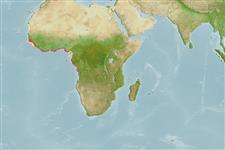
Atlantic Ocean: Eastern central Atlantic Ocean, from Dakhla in Western Sahara southward to Lobito Bay in Angola (Ref. 188, 5286, 81269, 81631), occasionally entering freshwater (Ref. 3509). Reports from Cape Verde Islands are based on an erroneous type locality for Clupea fimbriata by Bowdich (1825), which was later rectified as probably Gambia (Ref. 188, 5286, 94080).
Länge bei der ersten Reifung / Größe / Gewicht / Alter
Geschlechtsreife: Lm 17.0 range ? - 18.5 cm
Max length : 46.0 cm TL Männchen/unbestimmt; (Ref. 1989); common length : 25.0 cm TL Männchen/unbestimmt; (Ref. 187); max. veröff. Gewicht: 1.0 kg (Ref. 1989)
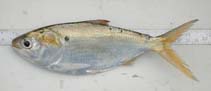
Rückenflossenstacheln (insgesamt) : 0; Rückenflossenweichstrahlen (insgesamt) : 16 - 19; Afterflossenstacheln: 0; Afterflossenweichstrahlen: 19 - 25; Wirbelzahl: 40 - 44. Diagnosis: Body fairly deep, compressed, scutes present along belly; upper jaw with distinct notch, into which tip of lower jaw fits; lower gillrakers long, fine and numerous, about 3 times as long as gill filaments, upper gillrakers bent sharply upward, V-shaped; pelvic fin rays with 1 unbranched and 7 branched rays; caudal fin tips long and pointed (Ref. 188). A faint dark spot behind gill cover, sometimes followed by others; dorsal fin tip black; caudal fin deep chrome yellow; golden tints on body (Ref. 188, 81269). Ethmalosa fimbriata resembles Sardinella aurita, Sardinella rouxi and especially Sardinella maderensis, but these are more slender, have a rounded upper jaw which is not notched and the upper gillrakers are not bent upward like an elbow (Ref. 188).
Body shape (shape guide): fusiform / normal; Cross section: compressed.
Ethmalosa fimbriata is found in fairly shallow coastal waters, lagoons and estuaries, and sometimes also in lower courses of coastal rivers, even more than 300 km up rivers (Ref. 187, 188, 81269, 81631). It feeds principally on phytoplankton, chiefly diatoms, filtered by the very fine gillraker sieve (Ref. 187, 188, 3166). It breeds throughout the year in waters of salinities 3.5-38 ppt, but with peaks in at least some areas; spawns in the sea, in estuaries and in rivers (Ref. 188). The largest fisheries are in Senegal, Sierra Leone, Ivory Coast, Nigeria and Cameroon, mainly in the dry season (Ref. 188).
Breeds all year in waters of salinities 3.5 to 38 ppt, but with peaks in at least some areas, becoming progressively later to south. Spawns in the sea, in estuaries and in rivers.
Whitehead, P.J.P., 1985. FAO Species Catalogue. Vol. 7. Clupeoid fishes of the world (suborder Clupeoidei). An annotated and illustrated catalogue of the herrings, sardines, pilchards, sprats, shads, anchovies and wolf-herrings. FAO Fish. Synop. 125(7/1):1-303. Rome: FAO. (Ref. 188)
IUCN Rote Liste Status (Ref. 130435: Version 2025-2 (Global))
Bedrohung für Menschen
Harmless
Nutzung durch Menschen
Fischereien: hoch kommerziell; Aquakultur: experimental
Tools
Zusatzinformationen
Download XML
Internet Quellen
Schätzungen auf der Grundlage von Modellen
Bevorzugte Temperatur (Ref.
123201): 20.2 - 27.9, mean 26.4 °C (based on 180 cells).
Phylogenetischer Diversitätsindex (Ref.
82804): PD
50 = 1.0000 [Uniqueness, from 0.5 = low to 2.0 = high].
Bayesian length-weight: a=0.00871 (0.00764 - 0.00993), b=3.06 (3.02 - 3.10), in cm total length, based on LWR estimates for this species (Ref.
93245).
Trophische Ebene (Ref.
69278): 2.5 ±0.25 se; based on food items.
Widerstandsfähigkeit (Ref.
120179): hoch, Verdopplung der Population dauert weniger als 15 Monate. (K=0.25-0.36; tm=1; Fec=16,000).
Prior r = 0.23, 95% CL = 0.15 - 0.34, Based on 1 full stock assessment.
Anfälligkeit der Fischerei (Ref.
59153): Low vulnerability (21 of 100).
🛈
Klimaanfälligkeit (Ref.
125649): High vulnerability (60 of 100).
🛈
Nährstoffe (Ref.
124155): Calcium = 181 [96, 321] mg/100g; Iron = 1.91 [1.04, 3.19] mg/100g; Protein = 19 [17, 21] %; Omega3 = 0.374 [0.211, 0.670] g/100g; Selenium = 65.7 [32.1, 137.4] μg/100g; VitaminA = 8.42 [3.24, 21.22] μg/100g; Zinc = 1.75 [1.23, 2.59] mg/100g (wet weight); based on
nutrient studies.