>
Clupeiformes (Herrings) >
Dorosomatidae (Gizzard shads and sardinellas)
Etymology: Hilsa: Bangladesh and Bengali local name for a fish.
More on author: Cuvier.
Lingkungan: lingkungan / zona iklim / kisaran kedalaman / jangkauan distribusi
Ekologi
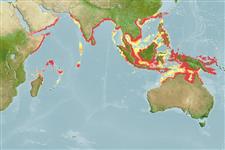
laut; air tawar; payau pelagic-neritic; anadromus (ruaya dari laut ke air tawar) (Ref. 51243); kisaran kedalaman 10 - ? m (Ref. 30573). Tropical; 25°N - 18°S, 43°E - 155°E (Ref. 54554)
Indo-West Pacific: probably all coasts of Indian Ocean, from Gulf of Oman and Gulf of Aden south to Durban and Madagascar, across the Bay of Bengal, Gulf of Thailand, Java Sea and north to Hong Kong and east to Papua New Guinea and possibly further (Ref. 188).
Panjang pada saat jatuh tempo pertama / Ukuran / Berat / umur
Kematangan: Lm 15.0 range ? - ? cm
Max length : 35.0 cm TL jantan/; (Ref. 11228); common length : 16.5 cm SL jantan/; (Ref. 188)
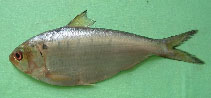
Duri punggung (Keseluruhan (total)) : 0; duri punggung lunak (Keseluruhan (total)) : 16 - 19; Duri dubur: 0; Sirip dubur lunak: 17 - 23. Diagnosis: Body fairly deep and compressed, belly with distinct keel of scutes; top of head with numerous fronto-parietal striae; upper jaw with median notch; gillrakers about 100 to 175, those on inner arches distinctly curled; outer row of gill filaments on first arch not more than half length of gillrakers; a series of small triangular scales above axil of pectoral fin; hind part of body scales perforated (Ref. 188). A black spot behind gill cover, usually followed by up to 10 spots along flank (Ref. 188).
Body shape (shape guide): fusiform / normal; Cross section: compressed.
Found in coastal waters (Ref. 3107, 30573); marine, pelagic, but entering estuaries and able to tolerate quite low salinities (7 ppt) (Ref. 188). Feeds chiefly on phytoplankton, mainly diatoms, also dinoflagellates, but also copepods, molluscan and crustacean larvae, prawns, amphipods and polychaetes (Ref. 188). Spawns, at least in Godavari estuary, around February (Ref. 188). Marketed fresh, dried, dried-salted and boiled. Made into fish balls.
Whitehead, P.J.P., 1985. FAO Species Catalogue. Vol. 7. Clupeoid fishes of the world (suborder Clupeoidei). An annotated and illustrated catalogue of the herrings, sardines, pilchards, sprats, shads, anchovies and wolf-herrings. FAO Fish. Synop. 125(7/1):1-303. Rome: FAO. (Ref. 188)
Status IUCN Red List (Ref. 130435: Version 2025-2 (Global))
ancaman kepada manusia
Harmless
penggunaan manusia
Perikanan: bernilai komersial tinggi; umpan: occasionally
Alat, peralatan
laporan khas
muat turun XML
Sumber internet
Estimasi berdasarkan model
Suhu yang disukai (Acuan
123201): 25.8 - 29.1, mean 28.3 °C (based on 772 cells).
Indeks keanekaragaman filogenetik (Acuan
82804): PD
50 = 1.0000 [Uniqueness, from 0.5 = low to 2.0 = high].
Bayesian length-weight: a=0.01000 (0.00625 - 0.01599), b=3.03 (2.89 - 3.17), in cm total length, based on LWR estimates for this species & (Sub)family-body (Ref.
93245).
Tingkat Trofik (Acuan
69278): 2.9 ±0.33 se; based on food items.
Generation time: 1.0 ( na - na) years. Estimated as median ln(3)/K based on 1
growth studies.
Daya lenting (Acuan
120179): Tinggi, Waktu penggandaan populasi minimum kurang dari 15 bulan (K=1.1).
Kerentanan Penangkapan Ikan (Ref.
59153): Low vulnerability (18 of 100).
🛈
Kerentanan Iklim (Ref.
125649): High to very high vulnerability (71 of 100).
🛈
Nutrisi (Ref.
124155): Calcium = 204 [116, 375] mg/100g; Iron = 2.01 [1.12, 3.29] mg/100g; Protein = 19.2 [18.1, 20.2] %; Omega3 = 0.411 [0.231, 0.728] g/100g; Selenium = 61.5 [30.1, 125.8] μg/100g; VitaminA = 9.95 [4.03, 23.19] μg/100g; Zinc = 1.78 [1.25, 2.60] mg/100g (wet weight);