>
Clupeiformes (Herrings) >
Dorosomatidae (Gizzard shads and sardinellas)
Etymology: Dorosoma: Greek, doris = lance + Greek, soma = body (Ref. 45335); cepedianum: Named after the French ichthyologist, Lacepede (Ref. 10294).
Eponymy: Bernard Germaine Etienne de la Ville, Comte de Lacépède (also spelled La Cepède) (1756– 1825), was a French naturalist and politician. [...] (Ref. 128868), visit book page.
More on author: Lesueur.
Environnement : milieu / zone climatique / profondeur / gamme de distribution
Écologie
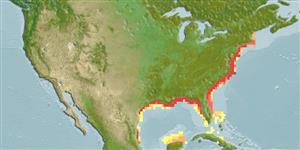
marin; eau douce; saumâtre pelagic-neritic; anadrome (Ref. 138280); profondeur 0 - 33 m (Ref. 39020). Subtropical; ? - 32°C (Ref. 12741); 49°N - 21°N, 108°W - 70°W (Ref. 188)
Northwest Atlantic: North America and Gulf of Mexico drainage (southeast South Dakota and central Minnesota, Great Lakes drainage, i.e. in Lake Erie, southern parts of Lakes Huron and Michigan, Lake Ontario basin; not Lake Superior; southernmost New York southward to the Mississippi system and to Gulf southward to Río Pánuco, Mexico.
Longueur à la première maturité / Taille / Poids / Âge
Maturité: Lm 36.1 range ? - ? cm
Max length : 57.0 cm FL mâle / non sexé; (Ref. 40637); common length : 35.0 cm SL mâle / non sexé; (Ref. 7251); poids max. publié: 2.0 kg (Ref. 40637); âge max. reporté: 10 années (Ref. 72462)
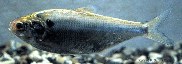
Épines dorsales (Total) : 0; Rayons mous dorsaux (Total) : 10 - 15; Épines anales: 0; Rayons mous anaux: 25 - 36; Vertèbres: 47 - 51. Body moderately deep; belly with 17 to 20 - 10 to 14 scutes. Mouth small; lower jaw short. Last dorsal fin ray long, about equal to distance from snout tip to mid-pectoral fin or beyond; anal fin long. Scales small, somewhat irregular. A dark spot behind gill opening. Gill rakers fine and numerous (Ref. 188). Branchiostegal rays 6 (Ref. 4639). Silvery to brassy, with a bluish back. Stomach thick-walled, gizzard-like (Ref. 7251).
Body shape (shape guide): fusiform / normal; Cross section: compressed.
Adults occur mainly in freshwater in large rivers, reservoirs, lakes, swamps, temporary floodwater pools, etc., but adults also found in brackish or saline water of estuaries or bays, preferring quieter open waters. Juveniles are found in great abundance well upstream from brackish water (Ref. 39041). Very young individuals apparently never enter brackish water (Ref. 38947). Larvae are most abundant in surface waters both day and night (Ref. 4639). Adults are herbivorous filter-feeders almost entirely. They breed near the surface in freshwater from late winter (mid-March) through most of the summer (at least to about mid-August). The adhesive eggs sink. Used to some extent as fertilizer and cattle food (Ref. 188).
Temperature range for spawning: 10°C-28.9°C (Ref. 39042), usually most active above 18°C (Ref. 862, 3742).
Whitehead, P.J.P., 1985. FAO Species Catalogue. Vol. 7. Clupeoid fishes of the world (suborder Clupeoidei). An annotated and illustrated catalogue of the herrings, sardines, pilchards, sprats, shads, anchovies and wolf-herrings. FAO Fish. Synop. 125(7/1):1-303. Rome: FAO. (Ref. 188)
Statut dans la liste rouge de l'IUCN (Ref. 130435: Version 2025-2 (Global))
Menace pour l'homme
Harmless
Utilisations par l'homme
Pêcheries: intérêt commercial mineur; pêche sportive: oui; appât: usually
Outils
Articles particuliers
Télécharger en XML
Sources Internet
Estimations basées sur des modèles
Température préférée (Réf.
123201): 12.8 - 26.8, mean 24 °C (based on 244 cells).
Indice de diversité phylogénétique (Réf.
82804): PD
50 = 0.5312 [Uniqueness, from 0.5 = low to 2.0 = high].
Bayesian length-weight: a=0.00871 (0.00765 - 0.00991), b=3.06 (3.03 - 3.09), in cm total length, based on LWR estimates for this species (Ref.
93245).
Niveau trophique (Réf.
69278): 2.4 ±0.21 se; based on food items.
Generation time: 6.1 ( na - na) years. Estimated as median ln(3)/K based on 2
growth studies.
Résilience (Réf.
120179): Milieu, temps minimum de doublement de population : 1,4 à 4,4 années (tm=2; tmax=6).
Vulnérabilité de la pêche (Ref.
59153): Low to moderate vulnerability (30 of 100).
🛈
Vulnérabilité climatique (Ref.
125649): Moderate to high vulnerability (49 of 100).
🛈
Nutriments (Ref.
124155): Calcium = 91.8 [52.8, 153.9] mg/100g; Iron = 1.56 [0.89, 2.61] mg/100g; Protein = 19.8 [18.6, 20.8] %; Omega3 = 0.498 [0.293, 0.826] g/100g; Selenium = 22.4 [11.4, 43.7] μg/100g; VitaminA = 6.48 [2.54, 17.22] μg/100g; Zinc = 1.11 [0.75, 1.57] mg/100g (wet weight);