>
Clupeiformes (Herrings) >
Dorosomatidae (Gizzard shads and sardinellas)
Etymology: Clupanodon: Latin, clupea = sardine, derived from Clupeus = shield; doubtless a reference to the scales covering the body of the fish (Ref. 45335).
More on author: Linnaeus.
Umwelt: Milieu / Klimazone / Tiefenbereich / Verbreitungsgebiet
Ökologie
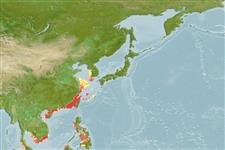
seewasser; süßwasser; brackwasser pelagic-neritic; anadrom (Ref. 138280); tiefenbereich 0 - 50 m (Ref. 188). Tropical; 41°N - 6°N, 98°E - 128°E (Ref. 188)
Northwest Pacific: China, apparently south to Viet Nam (Philippine records of Fowler appear doubtful). Eastern Indian Ocean: Specimens were recorded from Phuket Island, Thailand (Andaman Sea).
Größe / Gewicht / Alter
Geschlechtsreife: Lm ? range ? - ? cm
Max length : 26.0 cm SL Männchen/unbestimmt; (Ref. 188)
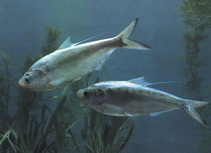
Rückenflossenstacheln (insgesamt) : 0; Afterflossenstacheln: 0; Afterflossenweichstrahlen: 22 - 28. Body moderately deep; belly with 16 to 19 (usually 18) + 9 to 12 (usually 10 or 11) total 27 to 31 (usually 29 or 30) scutes; pre-dorsal scutes present, 17 to 26 (usually 20 to 25). gill rakers of first arch at least 3/4 length of gill filaments. Vertebrae 43 to 46 (usually 44 or 45). A dark spot behind gill opening, followed by further spots on flank.
Body shape (shape guide): fusiform / normal; Cross section: compressed.
Found in coastal waters and in rivers, presumably tolerating brackish water, if not fully fresh condition. More data needed.
Lebenszyklus und Paarungsverhalten
Geschlechtsreife | Fortpflanzung | Ablaichen | Eier | Fruchtbarkeit | Larven
Whitehead, P.J.P., 1985. FAO Species Catalogue. Vol. 7. Clupeoid fishes of the world (suborder Clupeoidei). An annotated and illustrated catalogue of the herrings, sardines, pilchards, sprats, shads, anchovies and wolf-herrings. FAO Fish. Synop. 125(7/1):1-303. Rome: FAO. (Ref. 188)
IUCN Rote Liste Status (Ref. 130435: Version 2025-2 (Global))
Bedrohung für Menschen
Reports of ciguatera poisoning (Ref. 4690)
Nutzung durch Menschen
Fischereien: kommerziell
Tools
Zusatzinformationen
Download XML
Internet Quellen
Schätzungen auf der Grundlage von Modellen
Bevorzugte Temperatur (Ref.
123201): 24 - 29, mean 27.4 °C (based on 184 cells).
Phylogenetischer Diversitätsindex (Ref.
82804): PD
50 = 1.0000 [Uniqueness, from 0.5 = low to 2.0 = high].
Bayesian length-weight: a=0.00724 (0.00445 - 0.01179), b=3.14 (3.00 - 3.28), in cm total length, based on LWR estimates for this species & (Sub)family-body (Ref.
93245).
Trophische Ebene (Ref.
69278): 3.2 ±0.3 se; based on size and trophs of closest relatives
Generation time: 3.1 ( na - na) years. Estimated as median ln(3)/K based on 2
growth studies.
Widerstandsfähigkeit (Ref.
120179): hoch, Verdopplung der Population dauert weniger als 15 Monate. (Assuming tm=1).
Prior r = 1.19, 95% CL = 0.79 - 1.79, Based on 1 data-limited stock assessment.
Anfälligkeit der Fischerei (Ref.
59153): Low to moderate vulnerability (27 of 100).
🛈
Klimaanfälligkeit (Ref.
125649): Very high vulnerability (78 of 100).
🛈
Nährstoffe (Ref.
124155): Calcium = 190 [104, 334] mg/100g; Iron = 1.8 [1.1, 2.9] mg/100g; Protein = 19 [18, 20] %; Omega3 = 0.415 [0.238, 0.736] g/100g; Selenium = 38 [19, 72] μg/100g; VitaminA = 34.9 [15.0, 81.3] μg/100g; Zinc = 1.58 [1.12, 2.27] mg/100g (wet weight);