>
Blenniiformes (Blennies) >
Chaenopsidae (Pike-, tube- and flagblennies)
Etymology: Acanthemblemaria: Greek, akantha = thorn + Greek, emblema, -atos, anything that is nailed, knocked in; also anything with bass or high relief (Ref. 45335).
Eponymy: Mrs Mary George, whom Böhlke extolled as “…my secretary for the past five years and now parent and housewife, in appreciation of her assistance in all the activities of the department during that period.” (Ref. 128868), visit book page.
Окружающая среда: среда / климатическая зона / пределы глубины / диапазон распространения
экология
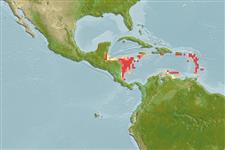
морской ассоциированный с рифами. Tropical; 18°N - 10°N, 90°W - 58°W (Ref. 56273)
Western Central Atlantic: Bahamas (Ref. 5521) to Tobago.
Размер / Вес / Возраст
половая зрелость: Lm ? range ? - ? cm
Max length : 5.1 cm TL самец/пол неопределен; (Ref. 5521)
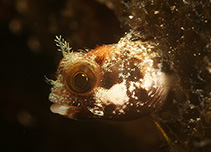
колючие лучи анального плавника: 2. Species distinguished by: sides of body with series of dark bands or large oval blotches; top of head often spiny; patch of cranial spines on nape extends posterior to supratemporal commissural pore, almost to dorsal-fin origin; inner rim of posterior infraorbital bone spinous or with tuberculate spines; two or more rows of teeth on each palatine bone; dorsal fin consisting of spines and segmented rays; total dorsal-fin elements 29 to 40. Common amongst Chaenopsids: small elongate fishes; largest species about 12 cm SL, most under 5 cm SL. Head usually with cirri or fleshy flaps on anterior nostrils, eyes, and sometimes laterally on nape; gill membranes continuous with each other across posteroventral surface of head. Each jaw with canine-like or incisor-like teeth anteriorly; teeth usually also present on vomer and often on palatines (roof of mouth). Dorsal-fin spines flexible, usually outnumbering the segmented soft rays (numbering 7 to 37), spinous and segmented-rayed portions forming a single, continuous fin; 2 flexible spines in anal fin; pelvic fins inserted anterior to position of pectoral fins, with 1 spine not visible externally and only 2 or 3 segmented (soft) rays; all fin rays, including caudal-fin rays, unbranched (simple). Lateral line absent. Scales absent (Ref.52855).
Body shape (shape guide): elongated.
Inhabits limestone slopes rather than patch reefs and these slopes are usually dotted with small brain corals, stinging coral, sea fans, whips, and sea urchins (Ref. 5521).
Жизненный цикл и брачное поведение
половая зрелость | размножение | нерест | икра | Плодовитость | личинки
Böhlke, J.E. and C.C.G. Chaplin, 1993. Fishes of the Bahamas and adjacent tropical waters. 2nd edition. University of Texas Press, Austin. (Ref. 5521)
Статус Красного Списка МСОП (Ref. 130435: Version 2025-2 (Global))
Угроза для людей
Harmless
Использование человеком
дополнительная информация
инструменты
Специальные отчеты
Скачать в формате XML
ресурсы в Интернет
Оценки, основанные на моделях
Предпочтительная температура (ссылка
123201): 27.4 - 28.4, mean 28 °C (based on 142 cells).
Индекс филогенетического разнообразия (ссылка
82804): PD
50 = 0.5000 [Uniqueness, from 0.5 = low to 2.0 = high].
Bayesian length-weight: a=0.00525 (0.00224 - 0.01232), b=3.07 (2.86 - 3.28), in cm total length, based on LWR estimates for this (Sub)family-body shape (Ref.
93245).
Трофический уровень (ссылка
69278): 3.3 ±0.4 se; based on size and trophs of closest relatives
Уязвимость рыбной ловли (Ref.
59153): Low vulnerability (10 of 100).
🛈
Питательные вещества (Ref.
124155): Calcium = 190 [92, 371] mg/100g; Iron = 0.925 [0.518, 1.663] mg/100g; Protein = 18 [17, 19] %; Omega3 = 0.104 [0.051, 0.203] g/100g; Selenium = 17.5 [7.4, 42.4] μg/100g; VitaminA = 384 [117, 1,309] μg/100g; Zinc = 2.31 [1.44, 3.49] mg/100g (wet weight);