Umwelt: Milieu / Klimazone / Tiefenbereich / Verbreitungsgebiet
Ökologie
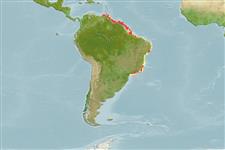
seewasser; süßwasser; brackwasser pelagic-neritic; tiefenbereich ? - 40 m (Ref. 188). Tropical; 12°N - 26°S, 64°W - 33°W (Ref. 188)
Western Atlantic: Trinidad and the Guianas; from Sergipe south to about Rio de Janeiro. Also found in freshwater. Also southern Brazil (Ref. 26938).
Größe / Gewicht / Alter
Geschlechtsreife: Lm ? range ? - ? cm
Max length : 22.0 cm TL Männchen/unbestimmt; (Ref. 125970); common length : 12.0 cm TL Männchen/unbestimmt; (Ref. 5217); max. veröff. Gewicht: 114.60 g (Ref. 125970)
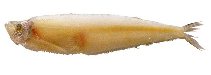
Rückenflossenstacheln (insgesamt) : 0; Afterflossenstacheln: 0; Afterflossenweichstrahlen: 70 - 85. Belly with a keel of scutes, but interrupted below pectoral fin base; scutes 7 or 8, then a gap, followed by 10 to 13, the outer edges of scutes smooth and not serrated. Upper jaw broad at midpoint, tapering posteriorly, the tip reaching or surpassing gill opening; no hypo-maxilla. Pectoral fins large; dorsal fin very small, set far back on body; anal fin long (Ref. 188). Sides of head silvery (Ref. 37032).
Body shape (shape guide): elongated; Cross section: compressed.
Occurs inshore, off river mouths, in estuaries, and some distance up rivers in freshwater (e.g., up Coppename River near Wilhelmina Mts, Suriname). Found over sand and mud bottom (Ref. 5217). Possibly spawns in rivers. Utilized as a food fish at some localities (Ref. 5217).
Lebenszyklus und Paarungsverhalten
Geschlechtsreife | Fortpflanzung | Ablaichen | Eier | Fruchtbarkeit | Larven
Whitehead, P.J.P., 1985. FAO Species Catalogue. Vol. 7. Clupeoid fishes of the world (suborder Clupeoidei). An annotated and illustrated catalogue of the herrings, sardines, pilchards, sprats, shads, anchovies and wolf-herrings. FAO Fish. Synop. 125(7/1):1-303. Rome: FAO. (Ref. 188)
IUCN Rote Liste Status (Ref. 130435: Version 2025-2 (Global))
Bedrohung für Menschen
Harmless
Nutzung durch Menschen
Fischereien: weniger kommerziell
Tools
Zusatzinformationen
Download XML
Internet Quellen
Schätzungen auf der Grundlage von Modellen
Bevorzugte Temperatur (Ref.
123201): 24.9 - 27.8, mean 27.3 °C (based on 84 cells).
Phylogenetischer Diversitätsindex (Ref.
82804): PD
50 = 0.6250 [Uniqueness, from 0.5 = low to 2.0 = high].
Bayesian length-weight: a=0.00380 (0.00272 - 0.00531), b=3.04 (2.95 - 3.13), in cm total length, based on LWR estimates for this species (Ref.
93245).
Trophische Ebene (Ref.
69278): 3.5 ±0.5 se; based on size and trophs of closest relatives
Generation time: 3.1 ( na - na) years. Estimated as median ln(3)/K based on 1
growth studies.
Widerstandsfähigkeit (Ref.
120179): mittel, Verdopplung der Population dauert 1,4 - 4,4 Jahre. (K=0.35).
Anfälligkeit der Fischerei (Ref.
59153): Low vulnerability (12 of 100).
🛈
Nährstoffe (Ref.
124155): Calcium = 195 [123, 416] mg/100g; Iron = 1.5 [0.9, 2.5] mg/100g; Protein = 18.5 [17.0, 19.9] %; Omega3 = 0.259 [0.128, 0.505] g/100g; Selenium = 34 [16, 75] μg/100g; VitaminA = 48 [18, 117] μg/100g; Zinc = 1.77 [1.23, 2.44] mg/100g (wet weight);