>
Eupercaria/misc (Various families in series Eupercaria) >
Lutjanidae (Snappers) > Lutjaninae
Etymology: Lutjanus: Malay, ikan lutjan, name of a fish.
More on author: Cuvier.
Lingkungan: lingkungan / zona iklim / kisaran kedalaman / jangkauan distribusi
Ekologi
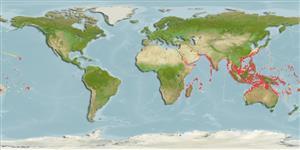
laut berasosiasi dengan karang; kisaran kedalaman 3 - 150 m (Ref. 9773). Tropical; 35°N - 31°S, 31°E - 145°W (Ref. 55)
Indo-Pacific: East Africa to Tahiti, north to southern Japan, south to Australia.
Panjang pada saat jatuh tempo pertama / Ukuran / Berat / umur
Kematangan: Lm ?, range 37 - ? cm
Max length : 85.5 cm TL jantan/; (Ref. 132370); common length : 60.0 cm TL jantan/; (Ref. 5450); Berat maksimum terpublikasi: 15.5 kg (Ref. 132370); Umur maksimum dilaporkan: 56 Tahun (Ref. 128164)
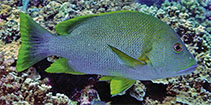
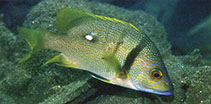
Duri punggung (Keseluruhan (total)) : 10; duri punggung lunak (Keseluruhan (total)) : 15 - 16; Duri dubur: 3; Sirip dubur lunak: 8. This species is distinguished by the following characters: body very deep, greatest depth 2.1-2.4 in SL; lips greatly thickened in adults; preopercular notch and knob moderately developed; vomerine tooth patch crescentic, without a medial posterior extension; tongue smooth, no teeth; gill rakers of first gill arch 6 + 11-12 =17-18; caudal fin truncate or slightly emarginate. Colour generally brown with a reddish tinge; each scale on side with a pale
brown border and 2-3 small bluish white spots in central portion; head with numerous undulating blue lines; lips tan; fins largely yellowish to dusky grey-brown; juveniles with a series of 3-8 brown bars on sides and a chalky white spot, with a broad blackish margin, present below anterior soft dorsal-fin rays at level of lateral line, preceded by similar-sized black spot on middle of side (Ref. 9821, 90102).
Body shape (shape guide): fusiform / normal; Cross section: oval.
Occasionally encountered in coral reefs or shallow inshore flats (Ref. 30573). Found singly or in small groups (up to 15 to 20 individuals). Adults on deep coastal slopes; juveniles on shallow algae-reef flats, often near freshwater run-offs (Ref. 48635). Feed on fishes, cephalopods and benthic crustaceans (Ref. 30573). An excellent food fish. In Hong Kong live fish markets (Ref. 27253). Caught with handlines, traps, and gill nets, occasionally trawled; important to artisanal fisheries and marketed mostly fresh (Ref. 9821). Minimum depth reported taken from Ref. 57178.
Allen, G.R., 1985. FAO Species Catalogue. Vol. 6. Snappers of the world. An annotated and illustrated catalogue of lutjanid species known to date. FAO Fish. Synop. 125(6):208 p. Rome: FAO. (Ref. 55)
Status IUCN Red List (Ref. 130435: Version 2025-2 (Global))
ancaman kepada manusia
Reports of ciguatera poisoning (Ref. 30298)
penggunaan manusia
Perikanan: komersial; Budidaya air: komersial; Ikan buruan: ya
Alat, peralatan
laporan khas
muat turun XML
Sumber internet
Estimasi berdasarkan model
Suhu yang disukai (Acuan
123201): 22.5 - 28.2, mean 26.5 °C (based on 353 cells).
Indeks keanekaragaman filogenetik (Acuan
82804): PD
50 = 0.5000 [Uniqueness, from 0.5 = low to 2.0 = high].
Bayesian length-weight: a=0.01445 (0.00959 - 0.02178), b=3.03 (2.92 - 3.14), in cm total length, based on LWR estimates for this species & Genus-body shape (Ref.
93245).
Tingkat Trofik (Acuan
69278): 4.0 ±0.51 se; based on food items.
Daya lenting (Acuan
120179): sedang, Waktu penggandaan populasi minimum 1.4 - 4.4 tahun (K=0.1-0.3; tmax=56;).
Kerentanan Penangkapan Ikan (Ref.
59153): High vulnerability (62 of 100).
🛈
Nutrisi (Ref.
124155): Calcium = 24.1 [15.5, 34.5] mg/100g; Iron = 0.291 [0.189, 0.438] mg/100g; Protein = 18.7 [17.2, 20.0] %; Omega3 = 0.131 [0.093, 0.177] g/100g; Selenium = 74.5 [51.6, 106.8] μg/100g; VitaminA = 110 [21, 389] μg/100g; Zinc = 0.367 [0.300, 0.499] mg/100g (wet weight);