>
Eupercaria/misc (Various families in series Eupercaria) >
Lethrinidae (Emperors or scavengers) > Lethrininae
Etymology: Lethrinus: Greek, lethrinia, a fish pertaining to genus Pagellus.
More on author: Valenciennes.
Milieu: milieu / Klimaatzone / Diepte / verspreidingsgebied
Ecologie
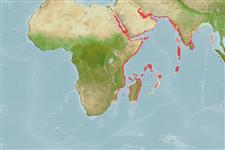
marien rifbewoner; standvastig; diepte ? - 40 m (Ref. 9710). Tropical; 30°N - 30°S, 33°E - 93°E
Indian Ocean: including the Red Sea and the Persian Gulf south to Durban, South Africa, then east to North Bay Reef, Andaman and Nicobar Islands. Reports of this species elsewhere are probably due to misidentification.
Lengte bij maturiteit / Grootte / Gewicht / Leeftijd
Maturiteit: Lm 21.3 range ? - ? cm
Max length : 40.0 cm TL mannelijk / geslacht onbekend; (Ref. 2295); common length : 25.0 cm TL mannelijk / geslacht onbekend; (Ref. 2295)
Korte beschrijving
Determinatiesleutels | Morfologie | Morfometrie
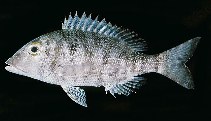
Dorsale stekels (totaal) : 10; Dorsale zachte stralen (totaal) : 9; Anale stekels: 3; Anale zachte stralen: 8. The inner surface of the pectoral fin base is densely scaled; posterior angle of the operculum is fully scaled; cheeks without scales. Color of body is dark gray or yellow-brown, head is brown-gray. The centers of scales are lighter. Sometimes there is an irregular pattern of broken dusky bars becoming whitish on the lower part of the body. The pectoral and pelvic fins are white of pinkish. The dorsal and anal fins are mottled white or yellowish with reddish edge. The caudal fin has indistinct reddish bands.
Body shape (shape guide): fusiform / normal; Cross section: oval.
Found in sandy areas near reefs during daytime, sometimes in small groups. At night, they are solitary and range over reef-flats and slopes where they feed primarily on echinoderms, mollusks and crustaceans (Ref. 2295). The taxonomy of this species has been considerably confused.
Levenscyclus en paargedrag
Maturiteit | Voortplanting | Paaien | Eieren | Fecunditeit | Larven
Exhibits juvenile hermaphroditism (Ref. 107020).
Carpenter, K.E. and G.R. Allen, 1989. FAO Species Catalogue. Vol. 9. Emperor fishes and large-eye breams of the world (family Lethrinidae). An annotated and illustrated catalogue of lethrinid species known to date. FAO Fish. Synop. 125(9):118 p. Rome: FAO. (Ref. 2295)
Status op de Rode Lijst van het IUCN (Ref. 130435: Version 2025-2 (Global))
Gevaar voor de mens
Harmless
Gebruik door de mens
Visserij: van minder commercieel belang
Tools
Speciale rapporten
Download XML
Internetbronnen
Schattingen op basis van modellen
Gewenste temperatuur (Ref.
123201): 25.5 - 29.2, mean 27.2 °C (based on 250 cells).
Fylogenetische diversiteitsindex (Ref.
82804): PD
50 = 0.5000 [Uniqueness, from 0.5 = low to 2.0 = high].
Bayesian length-weight: a=0.01288 (0.00795 - 0.02088), b=3.03 (2.90 - 3.16), in cm total length, based on LWR estimates for this species & Genus-body shape (Ref.
93245).
Trofisch niveau (Ref.
69278): 3.5 ±0.41 se; based on food items.
Weerstandsvermogen (Ref.
120179): Hoog, minimale populatieverdubbelingstijd minder dan 15 maanden (Preliminary K or Fecundity.).
Kwetsbaarheid van de visserij (Ref.
59153): Low vulnerability (23 of 100).
🛈
Kwetsbaarheid voor het klimaat (Ref.
125649): High to very high vulnerability (68 of 100).
🛈
Voedingsstoffen (Ref.
124155): Calcium = 62.6 [43.1, 100.3] mg/100g; Iron = 1.08 [0.69, 1.62] mg/100g; Protein = 20.3 [17.7, 22.5] %; Omega3 = 0.13 [0.09, 0.19] g/100g; Selenium = 45.4 [27.9, 78.8] μg/100g; VitaminA = 21 [4, 115] μg/100g; Zinc = 2.38 [1.76, 3.14] mg/100g (wet weight);