>
Eupercaria/misc (Various families in series Eupercaria) >
Lethrinidae (Emperors or scavengers) > Lethrininae
Etymology: Lethrinus: Greek, lethrinia, a fish pertaining to genus Pagellus.
More on author: Valenciennes.
Περιβάλλον: περιβάλλον / κλιματική ζώνη / εύρος βάθους / εύρος διανομής
Οικολογία
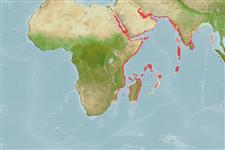
Θαλασσινό(ά) Υφαλόφιλο(α); μη μεταναστευτικό(ά); εύρος βάθους ? - 40 m (Ref. 9710). Tropical; 30°N - 30°S, 33°E - 93°E
Indian Ocean: including the Red Sea and the Persian Gulf south to Durban, South Africa, then east to North Bay Reef, Andaman and Nicobar Islands. Reports of this species elsewhere are probably due to misidentification.
Μήκος κατά την πρώτη ωρίμανση / Μέγεθος / Βάρος / Ηλικία
Γεννητική Ωρίμανση: Lm 21.3 range ? - ? cm
Max length : 40.0 cm TL αρσενικό/απροσδιόριστο; (Ref. 2295); common length : 25.0 cm TL αρσενικό/απροσδιόριστο; (Ref. 2295)
Σύντομη περιγραφή
Κλείδες προσδιορισμού | Μορφολογία | Μορφομετρία
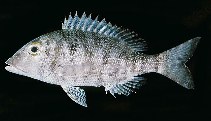
Ραχιαίες άκανθες (συνολικά) : 10; Μαλακές ραχιαίες ακτίνες (συνολικά) : 9; Εδρικές άκανθες: 3; Μαλακές εδρικές ακτίνες: 8. The inner surface of the pectoral fin base is densely scaled; posterior angle of the operculum is fully scaled; cheeks without scales. Color of body is dark gray or yellow-brown, head is brown-gray. The centers of scales are lighter. Sometimes there is an irregular pattern of broken dusky bars becoming whitish on the lower part of the body. The pectoral and pelvic fins are white of pinkish. The dorsal and anal fins are mottled white or yellowish with reddish edge. The caudal fin has indistinct reddish bands.
Body shape (shape guide): fusiform / normal; Cross section: oval.
Found in sandy areas near reefs during daytime, sometimes in small groups. At night, they are solitary and range over reef-flats and slopes where they feed primarily on echinoderms, mollusks and crustaceans (Ref. 2295). The taxonomy of this species has been considerably confused.
Exhibits juvenile hermaphroditism (Ref. 107020).
Carpenter, K.E. and G.R. Allen, 1989. FAO Species Catalogue. Vol. 9. Emperor fishes and large-eye breams of the world (family Lethrinidae). An annotated and illustrated catalogue of lethrinid species known to date. FAO Fish. Synop. 125(9):118 p. Rome: FAO. (Ref. 2295)
Κατάσταση Κόκκινου Καταλόγου IUCN (Ref. 130435: Version 2025-2 (Global))
Απειλή για τον άνθρωπο
Harmless
Ανθρώπινες χρήσεις
αλιεία: περιορισμένης εμπορικότητας
Εργαλεία
Ειδικές εκθέσεις
Λήψη XML
Διαδικτυακές πηγές
Εκτιμήσεις βάσει μοντέλων
Προτιμώμενη θερμοκρασία (Αναφ.
123201): 25.5 - 29.2, mean 27.2 °C (based on 250 cells).
Δείκτης φυλογενετικής ποικιλότητας (Αναφ.
82804): PD
50 = 0.5000 [Uniqueness, from 0.5 = low to 2.0 = high].
Bayesian length-weight: a=0.01288 (0.00795 - 0.02088), b=3.03 (2.90 - 3.16), in cm total length, based on LWR estimates for this species & Genus-body shape (Ref.
93245).
Τροφικό Επίπεδο (Αναφ.
69278): 3.5 ±0.41 se; based on food items.
Ελαστικότητα (Αναφ.
120179): Υψηλό, ελάχιστος χρόνος για διπλασιασμό πληθυσμού < 15 μήνες (Preliminary K or Fecundity.).
Ευπάθεια στην αλιεία (Ref.
59153): Low vulnerability (23 of 100).
🛈
Ευπάθεια στο κλίμα (Ref.
125649): High to very high vulnerability (68 of 100).
🛈
Θρεπτικά συστατικά (Ref.
124155): Calcium = 62.6 [43.1, 100.3] mg/100g; Iron = 1.08 [0.69, 1.62] mg/100g; Protein = 20.3 [17.7, 22.5] %; Omega3 = 0.13 [0.09, 0.19] g/100g; Selenium = 45.4 [27.9, 78.8] μg/100g; VitaminA = 21 [4, 115] μg/100g; Zinc = 2.38 [1.76, 3.14] mg/100g (wet weight);