>
Carangiformes (Jacks) >
Carangidae (Jacks and pompanos) > Caranginae
Etymology: Caranx: French, carangue, the name of a Caribbean fish; 1836 (Ref. 45335).
More on author: Forsskål.
البيئة: الوسط / المنطقة المناخية / نطاق العمق / نطاق التوزيع
البيئة
بحري; مياه مخلوطة مرتبطة بالشعاب; نطاق العمق 10 - 188 m (Ref. 58302). Tropical; 26°C - 29°C; 35°N - 37°S, 19°E - 129°W
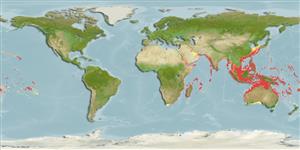
Indo-Pacific: Red Sea and east coast of Africa to the Hawaiian and Marquesan islands, north to southern Japan (Ref. 559) and the Ogasawara Islands, south to northern Australia. Hybrid with Caranx melampygus found in Hawaii (Ref. 58422).
الطول عند النضج الأول / الحجم / وزن / العمر
النضج: Lm 60.0 range ? - ? cm
Max length : 170 cm TL ذكر/ مختلط الجنس; (Ref. 9710); common length : 100.0 cm TL ذكر/ مختلط الجنس; (Ref. 5213); أعلا وزن تم نشرة: 80.0 kg (Ref. 4795)
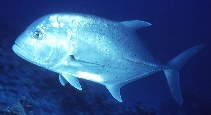
الأشواك الظهرية (المجموع) : 9; الأشعة الظهرية الناعمة (المجموع) : 18 - 21; شوكة شرجية: 3; أشعه شرجية لينه: 15 - 17; فقرات: 24. This species is distinguished by the following characters: gill rakers (including rudiments) 5-7 + 15-17 = 20-24; breast naked ventrally, typically with a small to large patch of prepelvic scales; colour in life of adults, head and body silvery grey to black above, usually paler below; fins usually uniformly grey to black, fish from turbid coastal waters often with yellow fins, the anal fin usually brightest (Ref. 9894).
Body shape (shape guide): fusiform / normal; Cross section: compressed.
Adults are pelagic over sand and rock (Ref. 58302). They occur singly and inhabit clear lagoon and seaward reefs (Ref. 9710). They feed on crustaceans (like crabs and spiny lobsters) and fishes at night (Ref. 4887). Juveniles are found in estuaries. Large individuals may be ciguatoxic. The largest trevally reaches 1.7 m in length and a weight of over 60 kg (Ref. 48635). Spawning occurs on shallow seaward reefs and offshore banks (Ref. 37816). Sold mostly fresh and dried salted.
دورة الحياة وسلوك التزاوج
النضج | التكاثر | وضع البيض | بيض | الخصوبة | اليرقات
Paxton, J.R., D.F. Hoese, G.R. Allen and J.E. Hanley, 1989. Pisces. Petromyzontidae to Carangidae. Zoological Catalogue of Australia, Vol. 7. Australian Government Publishing Service, Canberra, 665 p. (Ref. 7300)
حالة القائمة الحمراء للاتحاد الدولي لحفظ الطبيعة والموارد الطبيعية (Ref. 130435: Version 2025-2 (Global))
خطر للأنسان
Reports of ciguatera poisoning (Ref. 9710)
استخدامات بشرية
مصائد: تجاري; الأستزراع المائي: تجاري; لعبة سمكه: نعم; حوض مائي: احواض مائية عامة
أدوات
تقارير خاصة
تنزيل XML
مصادر علي الأنترنت
تقديرات تستند إلى النماذج
درجة الحرارة المفضلة (مرجع
123201): 21.2 - 28.4, mean 26.8 °C (based on 1154 cells).
مؤشر التنوع الشُعبي الوراثي (مرجع
82804): PD
50 = 0.5000 [Uniqueness, from 0.5 = low to 2.0 = high].
Bayesian length-weight: a=0.01698 (0.01429 - 0.02019), b=2.96 (2.93 - 2.99), in cm total length, based on LWR estimates for this species (Ref.
93245).
مستوى غذائي (مرجع
69278): 4.2 ±0.4 se; based on diet studies.
Generation time: 13.7 ( na - na) years. Estimated as median ln(3)/K based on 2
growth studies.
المرونه (مرجع
120179): منخفض, الحد الزمني الأدني لتضاعف عدد أفراد المجتمع 4.5-14 سنة (K=0.10; tm=3.5; tmax=11).
Prior r = 0.56, 95% CL = 0.37 - 0.83, Based on 2 data-limited stock assessments.
ضعف الصيد (Ref.
59153): High to very high vulnerability (74 of 100).
🛈
قابلية التأثر بالمناخ (Ref.
125649): High to very high vulnerability (72 of 100).
🛈
المغذيات (Ref.
124155): Calcium = 10.8 [4.6, 21.4] mg/100g; Iron = 0.288 [0.152, 0.572] mg/100g; Protein = 20.1 [17.8, 22.6] %; Omega3 = 0.122 [0.069, 0.211] g/100g; Selenium = 62.5 [30.3, 131.1] μg/100g; VitaminA = 56.9 [15.4, 194.6] μg/100g; Zinc = 0.476 [0.338, 0.698] mg/100g (wet weight);