>
Carangiformes (Jacks) >
Carangidae (Jacks and pompanos) > Caranginae
Etymology: Caranx: French, carangue, the name of a Caribbean fish; 1836 (Ref. 45335).
More on author: Forsskål.
Miljö: miljö / Klimatzon / djupintervall / distributionsområde
Ekologi
marina; brackvatten revassocierade; djupintervall 10 - 188 m (Ref. 58302). Tropical; 26°C - 29°C; 35°N - 37°S, 19°E - 129°W
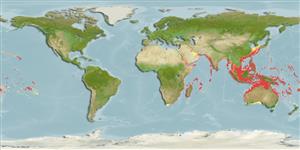
Indo-Pacific: Red Sea and east coast of Africa to the Hawaiian and Marquesan islands, north to southern Japan (Ref. 559) and the Ogasawara Islands, south to northern Australia. Hybrid with Caranx melampygus found in Hawaii (Ref. 58422).
Längd vid första mognad / Storlek / Vikt / Ålder
Könsmognad: Lm 60.0 range ? - ? cm
Max length : 170 cm TL hane/ej könsbestämd; (Ref. 9710); common length : 100.0 cm TL hane/ej könsbestämd; (Ref. 5213); publicerad maxvikt: 80.0 kg (Ref. 4795)
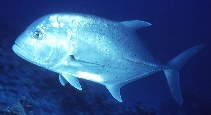
Taggstrålar i ryggfenan (totalt) : 9; Mjukstrålar i ryggfenan (totalt) : 18 - 21; Taggstrålar i analfenan: 3; Mjukstrålar i analfenan: 15 - 17; Ryggkotor: 24. This species is distinguished by the following characters: gill rakers (including rudiments) 5-7 + 15-17 = 20-24; breast naked ventrally, typically with a small to large patch of prepelvic scales; colour in life of adults, head and body silvery grey to black above, usually paler below; fins usually uniformly grey to black, fish from turbid coastal waters often with yellow fins, the anal fin usually brightest (Ref. 9894).
Body shape (shape guide): fusiform / normal; Cross section: compressed.
Adults are pelagic over sand and rock (Ref. 58302). They occur singly and inhabit clear lagoon and seaward reefs (Ref. 9710). They feed on crustaceans (like crabs and spiny lobsters) and fishes at night (Ref. 4887). Juveniles are found in estuaries. Large individuals may be ciguatoxic. The largest trevally reaches 1.7 m in length and a weight of over 60 kg (Ref. 48635). Spawning occurs on shallow seaward reefs and offshore banks (Ref. 37816). Sold mostly fresh and dried salted.
Livscykel och parningsbeteende
Könsmognad | Reproduktion | Lek | Ägg | Fekunditet | Larver
Paxton, J.R., D.F. Hoese, G.R. Allen and J.E. Hanley, 1989. Pisces. Petromyzontidae to Carangidae. Zoological Catalogue of Australia, Vol. 7. Australian Government Publishing Service, Canberra, 665 p. (Ref. 7300)
Status på IUCN:s rödlista (Ref. 130435: Version 2025-2 (Global))
Hot mot människor
Reports of ciguatera poisoning (Ref. 9710)
Mänskliga användningsområden
Fiskeri: kommersiell; Vattenbruk: kommersiell; sportfisk: ja; Akvarium: Offentliga akvarier
Verktyg
Särskilda rapporter
Ladda ner XML
Internet-källor
Uppskattningar baserade på modeller
Önskad temperatur (Ref.
123201): 21.2 - 28.4, mean 26.8 °C (based on 1154 cells).
Index för fylogenetisk mångfald (Ref.
82804): PD
50 = 0.5000 [Uniqueness, from 0.5 = low to 2.0 = high].
Bayesian length-weight: a=0.01698 (0.01429 - 0.02019), b=2.96 (2.93 - 2.99), in cm total length, based on LWR estimates for this species (Ref.
93245).
Trofisk nivå (Ref.
69278): 4.2 ±0.4 se; based on diet studies.
Generation time: 13.7 ( na - na) years. Estimated as median ln(3)/K based on 2
growth studies.
Resiliens (Ref.
120179): Låg, lägsta populationsfördubblingstid 4,5-14 år (K=0.10; tm=3.5; tmax=11).
Prior r = 0.56, 95% CL = 0.37 - 0.83, Based on 2 data-limited stock assessments.
Sårbarhet i fisket (Ref.
59153): High to very high vulnerability (74 of 100).
🛈
Sårbarhet för klimatet (Ref.
125649): High to very high vulnerability (72 of 100).
🛈
Näringsämnen (Ref.
124155): Calcium = 10.8 [4.6, 21.4] mg/100g; Iron = 0.288 [0.152, 0.572] mg/100g; Protein = 20.1 [17.8, 22.6] %; Omega3 = 0.122 [0.069, 0.211] g/100g; Selenium = 62.5 [30.3, 131.1] μg/100g; VitaminA = 56.9 [15.4, 194.6] μg/100g; Zinc = 0.476 [0.338, 0.698] mg/100g (wet weight);