Classification / Noms
Noms communs | Synonymes | Catalog of Fishes(Genre, Espèce) | ITIS | CoL | WoRMS | Cloffa
Environnement : milieu / zone climatique / profondeur / gamme de distribution
Écologie
marin récifal; profondeur 1 - 60 m (Ref. 86942). Tropical; 30°N - 37°S, 19°E - 167°W
Indo-West Pacific: East Africa to Samoa (Ref. 592) and Tonga (Ref. 53797), north to Japan, south to Australia (Ref. 3197) and New Caledonia (Ref. 9070).
Taille / Poids / Âge
Maturité: Lm ? range ? - ? cm
Max length : 41.0 cm TL mâle / non sexé; (Ref. 90102); common length : 30.0 cm TL mâle / non sexé; (Ref. 5450)
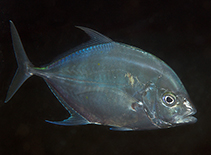
Épines dorsales (Total) : 8 - 9; Rayons mous dorsaux (Total) : 20 - 23; Épines anales: 3; Rayons mous anaux: 16 - 20. This species is distinguished by the following characters: D1 VII-VIII, D2 I,20-23 (usually 22 or 23); lobe of second dorsal fin filamentous in young, becoming shorter with age, in mature adults distinctly shorter than head length (larger than 25 cm fork length, height of second dorsal-fin lobe usually shorter than head length, and slightly to distinctly shorter than anal-fin lobe); A II + I,16-20; gill rakers including rudiments 5-8 + 15-19 = 21-27; straight part of lateral line with 16-20 scutes, and 31 to 50 total elements (including anterior scales); breast naked ventrally to distinctly behind origin of pelvic fins; laterally, naked area of breast typically extends diagonally to naked base of pectoral fins (rarely, naked areas of breast and pectoral-fin base interrupted laterally by a narrow band of scales); jaws with bands of villiform teeth, the bands widest anteriorly; in life, bluish green above, silvery grey below; sides with numerous, small yellow spots and a small black blotch on upper margin of opercle; second dorsal, anal, and caudal fins dusky, the latter sometimes yellowish; pectoral fins pale yellow; pelvic fins hyaline to pale grey (Ref. 9894); often with 5 diffuse dark bars (Ref. 90102).
Body shape (shape guide): short and / or deep; Cross section: compressed.
Adults are found in deep coastal reefs and rarely inshore (Ref 3197). They are usually in small groups over sand bottoms near reefs (Ref. 90102).
Cycle de vie et comportement reproducteur
Maturité | Reproduction | Frai | Œufs | Fécondité | Larves
Paxton, J.R., D.F. Hoese, G.R. Allen and J.E. Hanley, 1989. Pisces. Petromyzontidae to Carangidae. Zoological Catalogue of Australia, Vol. 7. Australian Government Publishing Service, Canberra, 665 p. (Ref. 7300)
Statut dans la liste rouge de l'IUCN (Ref. 130435: Version 2025-2 (Global))
Menace pour l'homme
Harmless
Utilisations par l'homme
Pêcheries: intérêt commercial mineur; pêche sportive: oui
Outils
Articles particuliers
Télécharger en XML
Sources Internet
Estimations basées sur des modèles
Température préférée (Réf.
123201): 24.4 - 28.9, mean 27.8 °C (based on 782 cells).
Indice de diversité phylogénétique (Réf.
82804): PD
50 = 0.6250 [Uniqueness, from 0.5 = low to 2.0 = high].
Bayesian length-weight: a=0.02630 (0.02102 - 0.03292), b=2.89 (2.83 - 2.95), in cm total length, based on LWR estimates for this species (Ref.
93245).
Niveau trophique (Réf.
69278): 4.4 ±0.7 se; based on diet studies.
Generation time: 1.5 ( na - na) years. Estimated as median ln(3)/K based on 1
growth studies.
Résilience (Réf.
120179): Haut, temps minimum de doublement de population inférieur à 15 mois (K=0.4-0.7;).
Vulnérabilité de la pêche (Ref.
59153): Low vulnerability (24 of 100).
🛈
Nutriments (Ref.
124155): Calcium = 37.8 [17.4, 84.3] mg/100g; Iron = 1.32 [0.57, 3.03] mg/100g; Protein = 19.7 [17.1, 21.9] %; Omega3 = 0.139 [0.073, 0.277] g/100g; Selenium = 9.3 [4.1, 23.7] μg/100g; VitaminA = 65.9 [10.8, 428.1] μg/100g; Zinc = 0.562 [0.291, 1.246] mg/100g (wet weight);