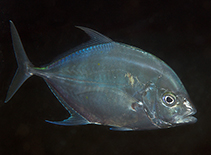
Môi trường: môi trường / vùng khí hậu / Mức độ sâu / phạm vi phân phối
Sinh thái học
biển cùng sống ở rạn san hô; mức độ sâu 1 - 60 m (Ref. 86942). Tropical; 30°N - 37°S, 19°E - 167°W
Indo-West Pacific: East Africa to Samoa (Ref. 592) and Tonga (Ref. 53797), north to Japan, south to Australia (Ref. 3197) and New Caledonia (Ref. 9070).
Bộ gần gũi / Khối lượng (Trọng lượng) / Tuổi
Chín muồi sinh dục: Lm ? range ? - ? cm
Max length : 41.0 cm TL con đực/không giới tính; (Ref. 90102); common length : 30.0 cm TL con đực/không giới tính; (Ref. 5450)
Các tia vây lưng cứng (tổng cộng) : 8 - 9; Các vây lưng mềm (tổng cộng) : 20 - 23; Tia cứng vây hậu môn: 3; Tia mềm vây hậu môn: 16 - 20. This species is distinguished by the following characters: D1 VII-VIII, D2 I,20-23 (usually 22 or 23); lobe of second dorsal fin filamentous in young, becoming shorter with age, in mature adults distinctly shorter than head length (larger than 25 cm fork length, height of second dorsal-fin lobe usually shorter than head length, and slightly to distinctly shorter than anal-fin lobe); A II + I,16-20; gill rakers including rudiments 5-8 + 15-19 = 21-27; straight part of lateral line with 16-20 scutes, and 31 to 50 total elements (including anterior scales); breast naked ventrally to distinctly behind origin of pelvic fins; laterally, naked area of breast typically extends diagonally to naked base of pectoral fins (rarely, naked areas of breast and pectoral-fin base interrupted laterally by a narrow band of scales); jaws with bands of villiform teeth, the bands widest anteriorly; in life, bluish green above, silvery grey below; sides with numerous, small yellow spots and a small black blotch on upper margin of opercle; second dorsal, anal, and caudal fins dusky, the latter sometimes yellowish; pectoral fins pale yellow; pelvic fins hyaline to pale grey (Ref. 9894); often with 5 diffuse dark bars (Ref. 90102).
Body shape (shape guide): short and / or deep; Cross section: compressed.
Adults are found in deep coastal reefs and rarely inshore (Ref 3197). They are usually in small groups over sand bottoms near reefs (Ref. 90102).
Vòng đời và hành vi giao phối
Chín muồi sinh dục | Sự tái sinh sản | Đẻ trứng | Các trứng | Sự sinh sản | Ấu trùng
Paxton, J.R., D.F. Hoese, G.R. Allen and J.E. Hanley, 1989. Pisces. Petromyzontidae to Carangidae. Zoological Catalogue of Australia, Vol. 7. Australian Government Publishing Service, Canberra, 665 p. (Ref. 7300)
Tình trạng Sách đỏ IUCN (Ref. 130435: Version 2025-2 (Global))
Mối đe dọa đối với con người
Harmless
Sử dụng của con người
Các nghề cá: buôn bán nhỏ; cá để chơi: đúng
Các công cụ
Báo cáo đặc biệt
Tải xuống XML
Các nguồn internet
Ước tính dựa trên mô hình
Nhiệt độ ưa thích (Tài liệu tham khảo
123201): 24.4 - 28.9, mean 27.8 °C (based on 782 cells).
Chỉ số đa dạng phát sinh loài (Tài liệu tham khảo
82804): PD
50 = 0.6250 [Uniqueness, from 0.5 = low to 2.0 = high].
Bayesian length-weight: a=0.02630 (0.02102 - 0.03292), b=2.89 (2.83 - 2.95), in cm total length, based on LWR estimates for this species (Ref.
93245).
Mức dinh dưỡng (Tài liệu tham khảo
69278): 4.4 ±0.7 se; based on diet studies.
Generation time: 1.5 ( na - na) years. Estimated as median ln(3)/K based on 1
growth studies.
Thích nghi nhanh (Tài liệu tham khảo
120179): Chiêù cao, thời gian nhân đôi của chủng quần tối thiểu là dưới 15 tháng (K=0.4-0.7;).
Sự dễ bị tổn thương của nghề đánh cá (Ref.
59153): Low vulnerability (24 of 100).
🛈
Chất dinh dưỡng (Ref.
124155): Calcium = 37.8 [17.4, 84.3] mg/100g; Iron = 1.32 [0.57, 3.03] mg/100g; Protein = 19.7 [17.1, 21.9] %; Omega3 = 0.139 [0.073, 0.277] g/100g; Selenium = 9.3 [4.1, 23.7] μg/100g; VitaminA = 65.9 [10.8, 428.1] μg/100g; Zinc = 0.562 [0.291, 1.246] mg/100g (wet weight);