Entorno: milieu / zona climática / rango de profundidad / gama de distribución
Ecología
marino asociado a arrecife; rango de profundidad ? - 100 m (Ref. 9710). Tropical; 36°N - 30°S, 32°E - 174°W
Indo-West Pacific: Red Sea and the East Africa to Palau and New Caledonia, north to Ryukyu and Ogasawara islands (Ref. 559, 26066), south to Australia. Recently reported from Tonga (Ref. 53797).
Tamaño / Peso / Edad
Madurez: Lm ? range ? - ? cm
Max length : 120 cm FL macho / no sexado; (Ref. 3678); common length : 90.0 cm TL macho / no sexado; (Ref. 5450); peso máximo publicado: 18.0 kg (Ref. 3287)
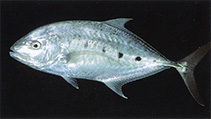
Espinas dorsales (total) : 9; Radios blandos dorsales (total) : 25 - 30; Espinas anales: 3; Radios blandos anales: 21 - 26; Vértebra: 24. This species is distinguished by having the following characters: body subovate and compressed, becoming elongate-ovate and slightly subcylindrical with age; profile of head and nape slightly angular becoming more steep with age; mouth cleft of adults distinctly below level of eye; D1 VIII, D2 I,25-30, lobe of second dorsal fin shorter than head length; A II (2 detached spines) + I, 21-26 (rarely 25 or 26); gill rakers (including rudiments) 6-8 + 17-21 = 22-27; vertebrae 10 + 14; straight part of lateral line with 18-27 scales followed by 15-21 small scutes; breast naked ventrally to distinctly behind origin of pelvic fins; breast squamation variable laterally, either separated from naked base of pectoral fins by a moderate to very narrow band of scales or naked area of breast uninterrupted to naked base of pectoral fins; colour of adults iridescent blue-green above, silvery below; with numerous small gold or brassy spots mainly on dorsal half; large adult with 3 (to 5) irregular black blotches on flanks (sometimes very indistinct or absent, the first below dorsal-fin lobe, the second at inflection point of lateral line, and the third slightly anterior to midpoint of straight part of lateral line (Ref. 9894, 90102).
Body shape (shape guide): fusiform / normal; Cross section: compressed.
Adults prefer rocky and coral reef areas, but also found on offshore banks (Ref. 30573). They occur singly or in small to large schools (Ref. 9710, 48635, 90102). They feed on small invertebrates and fishes (Ref. 5213).
Ciclo vital y comportamiento de apareamiento
Madurez | Reproducción | Puesta | Huevos | Fecundidad | Larva
Paxton, J.R., D.F. Hoese, G.R. Allen and J.E. Hanley, 1989. Pisces. Petromyzontidae to Carangidae. Zoological Catalogue of Australia, Vol. 7. Australian Government Publishing Service, Canberra, 665 p. (Ref. 7300)
Situación en la Lista Roja de la UICN (Ref. 130435: Version 2025-2 (Global))
Amenaza para el ser humano
Harmless
Usos humanos
Pesquerías: comercial; pesca deportiva: si
Herramientas
Informes especiales
Descargar XML
Fuentes de Internet
Estimaciones basadas en modelos
Temperatura preferida (Referencia
123201): 23.3 - 29.1, mean 27.9 °C (based on 2214 cells).
Índice de diversidad filogenética (Referencia
82804): PD
50 = 0.6250 [Uniqueness, from 0.5 = low to 2.0 = high].
Bayesian length-weight: a=0.01413 (0.00943 - 0.02116), b=2.92 (2.80 - 3.04), in cm total length, based on LWR estimates for this species & (Sub)family-body (Ref.
93245).
Nivel trófico (Referencia
69278): 4.4 ±0.5 se; based on diet studies.
Resiliencia (Referencia
120179): Bajo, población duplicada en un tiempo mínimo de 4.5-14 años (Preliminary K or Fecundity.).
Vulnerabilidad pesquera (Ref.
59153): Very high vulnerability (80 of 100).
🛈
Vulnerabilidad climática (Ref.
125649): Very high vulnerability (89 of 100).
🛈
Nutrientes (Ref.
124155): Calcium = 17.5 [10.9, 34.7] mg/100g; Iron = 0.933 [0.428, 1.823] mg/100g; Protein = 20.4 [17.8, 22.5] %; Omega3 = 0.158 [0.094, 0.266] g/100g; Selenium = 12.9 [6.3, 25.2] μg/100g; VitaminA = 42.1 [7.5, 259.0] μg/100g; Zinc = 0.536 [0.287, 1.204] mg/100g (wet weight); based on
nutrient studies.