>
Eupercaria/misc (Various families in series Eupercaria) >
Lutjanidae (Snappers) > Etelinae
Etymology: Pristipomoides: Greek, pristis = saw + Greek, poma, -atos = cover, operculum + Greek, oides = similar to (Ref. 45335).
Environnement : milieu / zone climatique / profondeur / gamme de distribution
Écologie
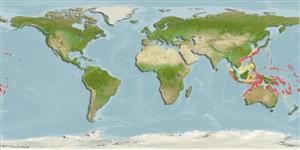
marin récifal; profondeur 90 - 360 m (Ref. 86942). Tropical; 31°N - 28°S, 93°E - 166°W (Ref. 55)
Pacific Ocean: southeastern Asia to Tahiti, north to the Ryukyu Islands, south to northeast Australia.
Taille / Poids / Âge
Maturité: Lm ? range ? - ? cm
Max length : 76.6 cm FL mâle / non sexé; (Ref. 107958); common length : 35.0 cm SL mâle / non sexé; (Ref. 9821); poids max. publié: 3.0 kg (Ref. 125599); âge max. reporté: 11 années (Ref. 82366)
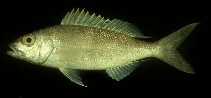
Épines dorsales (Total) : 10; Rayons mous dorsaux (Total) : 12; Épines anales: 3; Rayons mous anaux: 8. Interorbital space flat. Lower jaw slightly protruding. Bases of dorsal and anal fins without scales, their last soft rays extended into short filaments. Pectoral fins long, reaching level of anus. Scale rows on back running parallel to lateral line. Back and upper sides pale lavender or pinkish, grading to silvery ventrally. Head with dark spots on top. The margin of the dorsal fin yellow when fresh.
Body shape (shape guide): fusiform / normal; Cross section: oval.
Adults occur over rocky bottoms; off Guam, caught most abundantly between 180-270 m (Ref. 9821). They feed primarily on benthic fishes and to a lesser extent on crustaceans, squids, and pelagic tunicates. Marketed mainly fresh.
Cycle de vie et comportement reproducteur
Maturité | Reproduction | Frai | Œufs | Fécondité | Larves
Allen, G.R., 1985. FAO Species Catalogue. Vol. 6. Snappers of the world. An annotated and illustrated catalogue of lutjanid species known to date. FAO Fish. Synop. 125(6):208 p. Rome: FAO. (Ref. 55)
Statut dans la liste rouge de l'IUCN (Ref. 130435: Version 2025-2 (Global))
Menace pour l'homme
Harmless
Utilisations par l'homme
Pêcheries: hautement commercial
Outils
Articles particuliers
Télécharger en XML
Sources Internet
Estimations basées sur des modèles
Température préférée (Réf.
123201): 14.8 - 23.1, mean 19.3 °C (based on 136 cells).
Indice de diversité phylogénétique (Réf.
82804): PD
50 = 0.5005 [Uniqueness, from 0.5 = low to 2.0 = high].
Bayesian length-weight: a=0.01479 (0.01110 - 0.01972), b=2.95 (2.90 - 3.00), in cm total length, based on LWR estimates for this species (Ref.
93245).
Niveau trophique (Réf.
69278): 3.6 ±0.51 se; based on food items.
Generation time: 4.1 ( na - na) years. Estimated as median ln(3)/K based on 2
growth studies.
Résilience (Réf.
120179): Faible, temps minimum de doublement de population : 4,5 à 14 années (K=0.27-0.6; tmax=11;).
Vulnérabilité de la pêche (Ref.
59153): Moderate vulnerability (36 of 100).
🛈
Nutriments (Ref.
124155): Calcium = 33.9 [19.9, 60.9] mg/100g; Iron = 0.538 [0.290, 0.888] mg/100g; Protein = 18.9 [17.0, 20.6] %; Omega3 = 0.169 [0.111, 0.268] g/100g; Selenium = 51.8 [32.2, 89.0] μg/100g; VitaminA = 64.6 [22.4, 199.4] μg/100g; Zinc = 0.966 [0.694, 1.360] mg/100g (wet weight);