>
Eupercaria/misc (Various families in series Eupercaria) >
Lutjanidae (Snappers) > Etelinae
Etymology: Pristipomoides: Greek, pristis = saw + Greek, poma, -atos = cover, operculum + Greek, oides = similar to (Ref. 45335).
Ambiente: milieu / zona climática / intervalo de profundidade / gama de distribuição
Ecologia
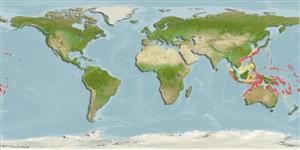
marinhas associadas(os) a recifes; intervalo de profundidade 90 - 360 m (Ref. 86942). Tropical; 31°N - 28°S, 93°E - 166°W (Ref. 55)
Pacific Ocean: southeastern Asia to Tahiti, north to the Ryukyu Islands, south to northeast Australia.
Tamanho / Peso / Idade
Maturidade: Lm ? range ? - ? cm
Max length : 76.6 cm FL macho/indeterminado; (Ref. 107958); common length : 35.0 cm SL macho/indeterminado; (Ref. 9821); peso máx. Publicado: 3.0 kg (Ref. 125599); Idade máx. registada: 11 anos (Ref. 82366)
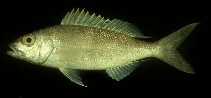
Espinhos dorsais (total) : 10; Raios dorsais moles (total) : 12; Espinhos anais: 3; Raios anais moles: 8. Interorbital space flat. Lower jaw slightly protruding. Bases of dorsal and anal fins without scales, their last soft rays extended into short filaments. Pectoral fins long, reaching level of anus. Scale rows on back running parallel to lateral line. Back and upper sides pale lavender or pinkish, grading to silvery ventrally. Head with dark spots on top. The margin of the dorsal fin yellow when fresh.
Body shape (shape guide): fusiform / normal; Cross section: oval.
Adults occur over rocky bottoms; off Guam, caught most abundantly between 180-270 m (Ref. 9821). They feed primarily on benthic fishes and to a lesser extent on crustaceans, squids, and pelagic tunicates. Marketed mainly fresh.
Ciclo de vida e comportamento de acasalamento
Maturidade | Reprodução | Desova | Ovos | Fecundidade | Larvas
Allen, G.R., 1985. FAO Species Catalogue. Vol. 6. Snappers of the world. An annotated and illustrated catalogue of lutjanid species known to date. FAO Fish. Synop. 125(6):208 p. Rome: FAO. (Ref. 55)
Categoria na Lista Vermelha da IUCN (Ref. 130435: Version 2025-2 (Global))
Ameaça para o homem
Harmless
Utilização humana
Pescarias: altamente comercial
Ferramentas
Relatórios especiais
Descarregue XML
Fontes da internet
Estimativas baseadas em modelos
Temperatura preferida (Ref.
123201): 14.8 - 23.1, mean 19.3 °C (based on 136 cells).
Índice de diversidade filogenética (Ref.
82804): PD
50 = 0.5005 [Uniqueness, from 0.5 = low to 2.0 = high].
Bayesian length-weight: a=0.01479 (0.01110 - 0.01972), b=2.95 (2.90 - 3.00), in cm total length, based on LWR estimates for this species (Ref.
93245).
Nível Trófico (Ref.
69278): 3.6 ±0.51 se; based on food items.
Generation time: 4.1 ( na - na) years. Estimated as median ln(3)/K based on 2
growth studies.
Resiliência (Ref.
120179): Baixo, tempo mínimo de duplicação da população 4,5 - 14 anos (K=0.27-0.6; tmax=11;).
Vulnerabilidade da pesca (Ref.
59153): Moderate vulnerability (36 of 100).
🛈
Nutrientes (Ref.
124155): Calcium = 33.9 [19.9, 60.9] mg/100g; Iron = 0.538 [0.290, 0.888] mg/100g; Protein = 18.9 [17.0, 20.6] %; Omega3 = 0.169 [0.111, 0.268] g/100g; Selenium = 51.8 [32.2, 89.0] μg/100g; VitaminA = 64.6 [22.4, 199.4] μg/100g; Zinc = 0.966 [0.694, 1.360] mg/100g (wet weight);