>
Cichliformes (Cichlids, convict blennies) >
Cichlidae (Cichlids) > Pseudocrenilabrinae
Etymology: Oreochromis: Latin, aurum = gold + Greek, chromis = a fish, perhaps a perch (Ref. 45335).
Eponymy: Henry Charles Vicars Hunter (1861–1934) was a Fellow of the Zoological Society of London, a big-game hunter and amateur naturalist. [...] (Ref. 128868), visit book page.
More on author: Günther.
Environnement : milieu / zone climatique / profondeur / gamme de distribution
Écologie
; eau douce benthopélagique. Tropical
Africa: endemic to Lake Chala in Kenya (Ref. 52331) and Tanzania (Ref. 118630).
Taille / Poids / Âge
Maturité: Lm ? range ? - ? cm
Max length : 30.0 cm SL mâle / non sexé; (Ref. 4967)
Description synthétique
Clés d'identification | Morphologie | Morphométrie
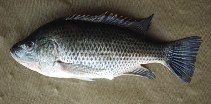
Épines dorsales (Total) : 16 - 17; Rayons mous dorsaux (Total) : 11 - 13; Épines anales: 3 - 4; Rayons mous anaux: 10 - 16; Vertèbres: 31 - 34. Diagnosis: A large bodied tilapia, with a relatively large and forward-facing snout, body at least 2.8 times as long as deep (Ref. 4967, 118638). The species can be distinguished by following characters: teeth very small, in narrow bands; pharyngeal bone narrow, its width about 26% length of head, with fine teeth, crowded posteriorly, the blade equal to the median length of the toothed area in young, about 1.5 times as long in adults; pectoral fin usually less than 36% of standard length; anal spines III-IV; scales of chest and belly very small, in some individuals showing an abrupt transition from the flank scales for a short distance behind the pectoral-pelvic interspace; in some the dorsal scales may also be small; and caudal peduncle at least 1.3 times longer than deep (Ref. 2, 4967). Males characterised by an intricate melanin pattern on the head, flank scales that are darker towards posterior side, and a background light grey-blue colour; the dorsal region is darker than the ventral, and ripe males with dark pectoral, anal, caudal fins, while the dorsal fin is dark with orange margins; females with less contrasting colours, with flanks uniformly grey or olive, with a lighter ventral region (Ref. 118638).
Body shape (shape guide): short and / or deep; Cross section: compressed.
Only found in Lake Chala (Ref. 2, 4967, 36900); several non-native tilapias are now established in this small lake as a result of stocking, and Oreochromis hunteri is apparently much less common than previously (Ref. 118638). Sometimes swimming in shoals (Ref. 36900, 55060). It feeds on algae and debris off the bottom between the rocks near the shore (Ref. 2, 55060). A maternal mouthbrooder (Ref. 118638). Fished in Lake Chala (Ref. 118638). IUCN conservation status is critically endangered (Ref. 118638).
Cycle de vie et comportement reproducteur
Maturité | Reproduction | Frai | Œufs | Fécondité | Larves
A maternal mouthbrooder (Ref. 118638).
Trewavas, E., 1983. Tilapiine fishes of the genera Sarotherodon, Oreochromis and Danakilia. British Mus. Nat. Hist., London, UK. 583 p. (Ref. 2)
Statut dans la liste rouge de l'IUCN (Ref. 130435: Version 2025-2 (Global))
Menace pour l'homme
Harmless
Utilisations par l'homme
Outils
Articles particuliers
Télécharger en XML
Sources Internet
Estimations basées sur des modèles
Indice de diversité phylogénétique (Réf.
82804): PD
50 = 0.5000 [Uniqueness, from 0.5 = low to 2.0 = high].
Bayesian length-weight: a=0.01905 (0.00846 - 0.04293), b=3.01 (2.82 - 3.20), in cm total length, based on LWR estimates for this (Sub)family-body shape (Ref.
93245).
Niveau trophique (Réf.
69278): 2.0 ±0.00 se; based on food items.
Résilience (Réf.
120179): Milieu, temps minimum de doublement de population : 1,4 à 4,4 années (Preliminary K or Fecundity.).
Vulnérabilité de la pêche (Ref.
59153): Low to moderate vulnerability (27 of 100).
🛈