>
Gobiiformes (Gobies) >
Gobiidae (Gobies) > Gobiinae
Etymology: Acentrogobius: Greek, a = without + Greek, kentron = sting + Latin gobius = gudgeon (Ref. 45335).
More on author: Herre.
Περιβάλλον: περιβάλλον / κλιματική ζώνη / εύρος βάθους / εύρος διανομής
Οικολογία
Θαλασσινό(ά); Υφάλμυρο βενθικό(ς); εύρος βάθους 1 - 7 m (Ref. 138301). Tropical
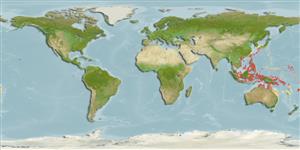
Indo-West Pacific: Saudi Arabia, Thailand, Indonesia, Palau, the Philippines, and Japan,
Μέγεθος / Βάρος / Ηλικία
Γεννητική Ωρίμανση: Lm ? range ? - ? cm
Max length : 3.3 cm SL αρσενικό/απροσδιόριστο; (Ref. 7050)
Σύντομη περιγραφή
Κλείδες προσδιορισμού | Μορφολογία | Μορφομετρία
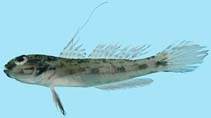
Ραχιαίες άκανθες (συνολικά) : 7; Μαλακές ραχιαίες ακτίνες (συνολικά) : 9 - 10; Εδρικές άκανθες: 1; Μαλακές εδρικές ακτίνες: 9 - 10. This species is distinguished from all its congeners by the following set of characters: D VI-I, 9 or 10; anal-fin rays I,9 or 10; pectoral-fin rays 16 or 17; longitudinal scale series 27-29; transverse scales 9-11 (modally 10); pre-dorsal scales 0-9; first to third spines of the first dorsal fin with filamentous tips (usually the second spine has the longest); head and nape naked with body mostly covered with ctenoid scales; cycloid or weakly ctenoid scales on thorax and just above pectoral-fin base; papillae on cheek forming a longitudinal pattern while papillae on chin forming single transverse row. Colouration: brown stripes two from just behind pectoral-fin base to caudal-fin base; body with dark brown lateral blotches 5 (rarely 6), between lateral stripes; when fresh, blue spots (sometimes indistinct) between and just above lateral stripes, absent on lateral blotches; a black blotch on opercle; single black spot on chin; longitudinal red stripe on upper margin of caudal fin, with longitudinal bluish or yellowish stripe just below red stripe (Ref. 138301).
Body shape (shape guide): elongated; Cross section: oval.
Inhabits intertidal to subtidal zones (up to 7 m) in river mouths and coastal areas, with field surveys observing its preference for more clay-like substrate and often collected with Caragobius urolepis at the tidal flat in Japan (Ref. 138301). Also collected from silty sand and mud bottoms, usually near mouth of streams, and occasionally near reefs in 1-4 m (Ref. 90102).
Κύκλος ζωής και συμπεριφορά ζευγαρώματος
Γεννητική Ωρίμανση | Αναπαραγωγή | Γεννοβολία | Αβγά | Γονιμότητα | Προνύμφες
Koreeda, R. and H. Motomura, 2025. A new species of Acentrogobius (Perciformes: Gobiidae) from the Indo-West Pacific, with a revised diagnosis for Acentrogobius suluensis (Herre 1927). Ichthyol. Res. 2025. (Ref. 138301)
Κατάσταση Κόκκινου Καταλόγου IUCN (Ref. 130435: Version 2025-2 (Global))
Απειλή για τον άνθρωπο
Harmless
Ανθρώπινες χρήσεις
Εργαλεία
Ειδικές εκθέσεις
Λήψη XML
Διαδικτυακές πηγές
Εκτιμήσεις βάσει μοντέλων
Προτιμώμενη θερμοκρασία (Αναφ.
123201): 26 - 29.3, mean 28.8 °C (based on 1331 cells).
Δείκτης φυλογενετικής ποικιλότητας (Αναφ.
82804): PD
50 = 0.5000 [Uniqueness, from 0.5 = low to 2.0 = high].
Bayesian length-weight: a=0.00794 (0.00340 - 0.01856), b=3.09 (2.91 - 3.27), in cm total length, based on LWR estimates for this Genus-body shape (Ref.
93245).
Τροφικό Επίπεδο (Αναφ.
69278): 3.2 ±0.4 se; based on size and trophs of closest relatives
Ελαστικότητα (Αναφ.
120179): Υψηλό, ελάχιστος χρόνος για διπλασιασμό πληθυσμού < 15 μήνες (Preliminary K or Fecundity.).
Ευπάθεια στην αλιεία (Ref.
59153): Low vulnerability (10 of 100).
🛈