Classificazione / Nomi
Nomi Comuni | Sinonimi | Catalog of Fishes(Genere, Specie) | ITIS | CoL | WoRMS | Cloffa
>
Petromyzontiformes (Lampreys) >
Petromyzontidae (Northern lampreys) > Lampetrinae
Etymology: Entosphenus: entos (Gr.), within; sphenos (Gr.), wedge, referring to wedge-shaped tooth within mouth on tongue of E. tridentatus (See ETYFish); lethophagus: lethe (Gr.), forgetting or forgetfulness; phagein (Gr.), to eat, i.e., not eating (an adjective), referring to adults, which do not eat before they spawn and die (See ETYFish).
More on author: Hubbs.
Ambiente: milieu / zona climatica / distribuzione batimetrica / gamma di distribuzione
Ecologia
; acqua dolce demersale; non migratori (Ref. 126106). Temperate; 43°N - 41°N
North America: Klamath River in south central Oregon (rare) and Pit River in northeastern California, USA.
Dimensione / Peso / Età
Maturità: Lm ? range ? - ? cm
Max length : 22.0 cm TL maschio/sesso non determinato; (Ref. 5723); common length : 14.0 cm TL maschio/sesso non determinato; (Ref. 12193)
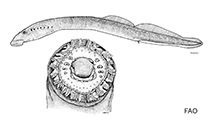
Spine dorsali (totale) : 0; Spine anali: 0. Adults: 12.4-18.4 cm TL. Adult body proportions, as percentage of TL (based on ten specimens 12.6-18.4 cm TL): prebranchial length, 8.2-13.3; branchial length, 8.4-10.8; trunk length, 43.4-51.6; tail length, 28.8-35.3; eye length, 1.6-3.2; disc length, 4.1-6.1; urogenital papilla length, 16.0 (percentage of branchial length in a spawning male measuring 12.9 cm TL); trunk myomeres, 58-73. Adult dentition: supraoral lamina, 2-3 unicuspid teeth, usually 3; infraoral lamina, 5-7 unicuspid teeth; 4 endolaterals on each side; endolateral formula, typically 2-2-2-2 or 2-3-3-2, the first and fourth endolaterals may also rarely be unicuspid; 2-3 rows of anterials; first row of anterials, 1 or 5 unicuspid teeth; exolaterals absent; 1 row of posterials with 10-17 teeth, of which 0-12 are bicuspid and the rest unicuspid; transverse lingual lamina, 15-20 unicuspid teeth, the median one slightly enlarged; longitudinal lingual laminae each with undetermined number of unicuspid teeth. Velar tentacles in adults, 5-12, with tubercles; median tentacle shorter than the lateral ones immediately next to it; body coloration (preserved), ventral aspect whitish; oral papillae, 5-26 (Ref. 89241).
Body shape (shape guide): eel-like.
Adults inhabit riffles and runs of clear streams. Ammocoetes larvae occur near weed beds and sand bars. Non-parasitic (Ref. 5723). Freshwater; adults from Crooked Creek, Oregon are sexually mature in mid-March (Ref. 89241).
Ciclo vitale e comportamento di accoppiamento
Maturità | Riproduzione | Deposizione | Uova | Fecondità | Larve
Page, L.M. and B.M. Burr, 1991. A field guide to freshwater fishes of North America north of Mexico. Houghton Mifflin Company, Boston. 432 p. (Ref. 5723)
Stato della Lista Rossa IUCN (Ref. 130435: Version 2025-2 (Global))
Minaccia per l'uomo
Harmless
Usi umani
Pesca: di nessun interesse
Strumenti
Rapporti speciali
Scarica XML
Fonti Internet
Stime basate su modelli
Indice di diversità filogenetica (Fonte Biblio.
82804): PD
50 = 0.5156 [Uniqueness, from 0.5 = low to 2.0 = high].
Bayesian length-weight: a=0.00132 (0.00060 - 0.00290), b=2.99 (2.80 - 3.18), in cm total length, based on LWR estimates for this (Sub)family-body shape (Ref.
93245).
Livello trofico (Fonte Biblio.
69278): 4.1 ±0.7 se; based on size and trophs of closest relatives
Resilienza (Fonte Biblio.
120179): Basso, tempo minimo di raddoppiamento della popolazione 4.5 - 14 anni (Semelparous species, assuming tm (= tmax) > 4).
Vulnerabilità della pesca (Ref.
59153): Low vulnerability (12 of 100).
🛈