>
Petromyzontiformes (Lampreys) >
Petromyzontidae (Northern lampreys) > Lampetrinae
Etymology: Entosphenus: entos (Gr.), within; sphenos (Gr.), wedge, referring to wedge-shaped tooth within mouth on tongue of E. tridentatus (See ETYFish); lethophagus: lethe (Gr.), forgetting or forgetfulness; phagein (Gr.), to eat, i.e., not eating (an adjective), referring to adults, which do not eat before they spawn and die (See ETYFish).
More on author: Hubbs.
Môi trường: môi trường / vùng khí hậu / Mức độ sâu / phạm vi phân phối
Sinh thái học
; nước ngọt gần đáy; không di cư (Ref. 126106). Temperate; 43°N - 41°N
North America: Klamath River in south central Oregon (rare) and Pit River in northeastern California, USA.
Bộ gần gũi / Khối lượng (Trọng lượng) / Tuổi
Chín muồi sinh dục: Lm ? range ? - ? cm
Max length : 22.0 cm TL con đực/không giới tính; (Ref. 5723); common length : 14.0 cm TL con đực/không giới tính; (Ref. 12193)
Các tia vây lưng cứng (tổng cộng) : 0; Tia cứng vây hậu môn: 0. Adults: 12.4-18.4 cm TL. Adult body proportions, as percentage of TL (based on ten specimens 12.6-18.4 cm TL): prebranchial length, 8.2-13.3; branchial length, 8.4-10.8; trunk length, 43.4-51.6; tail length, 28.8-35.3; eye length, 1.6-3.2; disc length, 4.1-6.1; urogenital papilla length, 16.0 (percentage of branchial length in a spawning male measuring 12.9 cm TL); trunk myomeres, 58-73. Adult dentition: supraoral lamina, 2-3 unicuspid teeth, usually 3; infraoral lamina, 5-7 unicuspid teeth; 4 endolaterals on each side; endolateral formula, typically 2-2-2-2 or 2-3-3-2, the first and fourth endolaterals may also rarely be unicuspid; 2-3 rows of anterials; first row of anterials, 1 or 5 unicuspid teeth; exolaterals absent; 1 row of posterials with 10-17 teeth, of which 0-12 are bicuspid and the rest unicuspid; transverse lingual lamina, 15-20 unicuspid teeth, the median one slightly enlarged; longitudinal lingual laminae each with undetermined number of unicuspid teeth. Velar tentacles in adults, 5-12, with tubercles; median tentacle shorter than the lateral ones immediately next to it; body coloration (preserved), ventral aspect whitish; oral papillae, 5-26 (Ref. 89241).
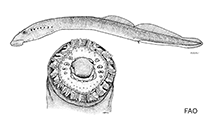
Body shape (shape guide): eel-like.
Adults inhabit riffles and runs of clear streams. Ammocoetes larvae occur near weed beds and sand bars. Non-parasitic (Ref. 5723). Freshwater; adults from Crooked Creek, Oregon are sexually mature in mid-March (Ref. 89241).
Vòng đời và hành vi giao phối
Chín muồi sinh dục | Sự tái sinh sản | Đẻ trứng | Các trứng | Sự sinh sản | Ấu trùng
Page, L.M. and B.M. Burr, 1991. A field guide to freshwater fishes of North America north of Mexico. Houghton Mifflin Company, Boston. 432 p. (Ref. 5723)
Tình trạng Sách đỏ IUCN (Ref. 130435: Version 2025-2 (Global))
Mối đe dọa đối với con người
Harmless
Sử dụng của con người
Các nghề cá: không ích lợi (thú vị)
Các công cụ
Báo cáo đặc biệt
Tải xuống XML
Các nguồn internet
Ước tính dựa trên mô hình
Chỉ số đa dạng phát sinh loài (Tài liệu tham khảo
82804): PD
50 = 0.5156 [Uniqueness, from 0.5 = low to 2.0 = high].
Bayesian length-weight: a=0.00132 (0.00060 - 0.00290), b=2.99 (2.80 - 3.18), in cm total length, based on LWR estimates for this (Sub)family-body shape (Ref.
93245).
Mức dinh dưỡng (Tài liệu tham khảo
69278): 4.1 ±0.7 se; based on size and trophs of closest relatives
Thích nghi nhanh (Tài liệu tham khảo
120179): thấp, thời gian nhân đôi của chủng quần tối thiểu là 4.5 - 14 năm (Semelparous species, assuming tm (= tmax) > 4).
Sự dễ bị tổn thương của nghề đánh cá (Ref.
59153): Low vulnerability (12 of 100).
🛈