Klassifizierung / Names
Namen | Synonyme | Catalog of Fishes(Gattung, Arten) | ITIS | CoL | WoRMS | Cloffa
>
Gadiformes (Cods) >
Macrouridae (Grenadiers or rattails)
Etymology: Hymenocephalus: Named for its transparent membrane-like head covering (‘‘hymen head’’) and fragile nature of head bones (Ref. 100825).
Eponymy: William ‘Bill’ Harding Longley (1881–1937) was a Canadian-born botanist and ichthyologist who studied colours and patterns of tropical reef fish. [...] (Ref. 128868), visit book page.
More on authors: Marshall & Iwamoto.
Umwelt: Milieu / Klimazone / Tiefenbereich / Verbreitungsgebiet
Ökologie
seewasser bathypelagisch; tiefenbereich 400 - 900 m (Ref. 37108). Deep-water
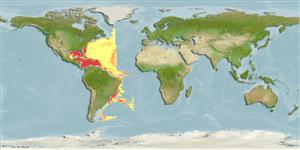
Western Central Atlantic: Straits of Florida, Gulf of Mexico, Caribbean Sea, and off Rio de Janeiro, Brazil.
Größe / Gewicht / Alter
Geschlechtsreife: Lm ? range ? - ? cm
Max length : 39.5 cm TL Männchen/unbestimmt; (Ref. 115012); max. veröff. Gewicht: 270.90 g (Ref. 115012)
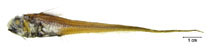
Rückenflossenweichstrahlen (insgesamt) : 10 - 13. This species is distinguished by the following characters: pelvic fin rays 12-14 (usually 13-14); pectoral fin rays 14-17; projecting snout, 20-25% HL; short barbel, 4-5% HL, does not reach vertical through anterior margin of orbit; moderate orbit diameter, 28-35% HL; infraorbital width 12-15% HL; moderately long preopercular supporter, with angle at rear margin, 5-6% HL; 23-28 gill rakers; ventral striae reaching to ½ to ? distance from pelvic fin bases to periproct; otolith has moderately high predorsal lobe, with colliculi separated, closely placed across collum, terminating at some distance from anterior and posterior rims of otolith; otolith length to height (OL:OH), 1.05; total colliculum length to pseudocolliculum length (TCL:PCL), 2.6-2.8 (Ref. 98298).
Body shape (shape guide): elongated; Cross section: compressed.
Lebenszyklus und Paarungsverhalten
Geschlechtsreife | Fortpflanzung | Ablaichen | Eier | Fruchtbarkeit | Larven
Cohen, D.M., A.W. Ebeling, T. Iwamoto, S.B. McDowell, N.B. Marshall, D.E. Rosen, P. Sonoda, W.H. Weed III and L.P. Woods, 1973. Fishes of the western North Atlantic. Part six. New Haven, Sears Found. Mar. Res., Yale Univ. (Ref. 37108)
IUCN Rote Liste Status (Ref. 130435: Version 2025-2 (Global))
Bedrohung für Menschen
Harmless
Nutzung durch Menschen
Tools
Zusatzinformationen
Download XML
Internet Quellen
Schätzungen auf der Grundlage von Modellen
Bevorzugte Temperatur (Ref.
123201): 7.1 - 13.9, mean 9.5 °C (based on 83 cells).
Phylogenetischer Diversitätsindex (Ref.
82804): PD
50 = 0.5000 [Uniqueness, from 0.5 = low to 2.0 = high].
Bayesian length-weight: a=0.00145 (0.00087 - 0.00240), b=3.21 (3.06 - 3.36), in cm total length, based on LWR estimates for this species & (Sub)family-body (Ref.
93245).
Trophische Ebene (Ref.
69278): 3.5 ±0.4 se; based on size and trophs of closest relatives
Widerstandsfähigkeit (Ref.
120179): mittel, Verdopplung der Population dauert 1,4 - 4,4 Jahre. (Assuming tmax>3).
Anfälligkeit der Fischerei (Ref.
59153): Low to moderate vulnerability (30 of 100).
🛈