Elasmobranchii (tubarões e raias) (sharks and rays) >
Rhinopristiformes (Shovelnose rays) >
Pristidae (Sawfishes)
Etymology: Pristis: Greek, pristis = saw (Ref. 45335).
Taxonomic Remarks
Synonym of Pristis pristis (Linnaeus, 1758) according to Faria et al., 2012 (Ref. 93006:11) and Weigmann, 2016 (Ref. 106604); status confirmed by William White (pers. Comm., Feb 2016).
Ambiente: milieu / zona climática / intervalo de profundidade / gama de distribuição
Ecologia
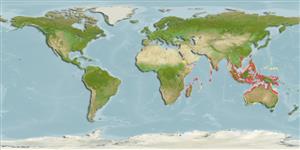
marinhas; Água doce; estuarina demersal; anfídromo (Ref. 51243); intervalo de profundidade 0 - 10 m (Ref. 27000). Tropical; 22°N - 39°S, 20°E - 154°E
Indo-West Pacific: East Africa to New Guinea, north to the Philippines and Viet Nam, south to Australia. Also Atlantic and eastern Pacific if Pristis perotteti and Pristis zephyreus are synonymized with this species. The original description of Pristis microdon did not give a locality, but most authors have used the name Pristis microdon for the Indo-West Pacific sawfishes of this species group as contrasted from the Atlantic Pristis perotteti and the eastern Pacific Pristis zephyreus.
Comprimento na primeira maturidade / Tamanho / Peso / Idade
Maturidade: Lm 270.0, range 240 - 300 cm
Max length : 700 cm TL macho/indeterminado; (Ref. 58048); common length : 500 cm TL macho/indeterminado; (Ref. 2683); peso máx. Publicado: 600.0 kg (Ref. 3164); Idade máx. registada: 30 anos (Ref. 9859)
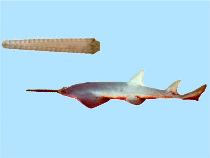
Espinhos dorsais (total) : 0; Espinhos anais: 0. Diagnosis: A heavily-bodied sawfish with a short but massive saw which is broad-based, strongly tapering and with 14-22 very large teeth on each side; space between last 2 saw-teeth on sides less than 2 times space between first 2 teeth (Ref. 5578). Pectoral fins high and angular, 1st dorsal fin mostly in front of pelvic fins, and caudal fin with pronounced lower lobe (Ref. 5578).
Body shape (shape guide): elongated; Cross section: compressed.
Inhabits sandy or muddy bottoms of shallow coastal waters, estuaries, river mouths, and freshwater rivers and lakes. Usually found in turbid channels of large rivers over soft mud bottoms (Ref. 2847, 44894). Adults usually found in estuaries and young ascend into fresh water. Large adults can also be found in fresh water, but are rarely caught (Ref. 12693). Feeds on benthic animals and small schooling species. Ovoviviparous (Ref. 50449). The saw is used for grubbing and attacking prey as well as for defense. The saws sell as tourist souvenirs (Ref. 7248). Occasionally caught by demersal tangle net and trawl fisheries in the Arafura Sea; possibly extinct in parts of the Indo-Pacific; highly susceptible to gill nets. Utilized for its fins and meat (both of very high value), and skin and cartilage (Ref.58048). Attains 4.6 m total length (Ref. 52193).
Ciclo de vida e comportamento de acasalamento
Maturidade | Reprodução | Desova | Ovos | Fecundidade | Larvas
Ovoviviparous, embryos feed solely on yolk (Ref. 50449). Gestation period about 5 months (Ref. 9859); litter size 1- 13 (Ref. 5578). Probably breeds in freshwater (Ref.58048).
Last, P.R. and J.D. Stevens, 1994. Sharks and rays of Australia. CSIRO, Australia. 513 p. (Ref. 6871)
Categoria na Lista Vermelha da IUCN (Ref. 130435: Version 2025-2 (Global))
Ameaça para o homem
Traumatogenic (Ref. 4690)
Utilização humana
Pescarias: pouco comercial; peixe desportivo: sim
Ferramentas
Relatórios especiais
Descarregue XML
Fontes da internet
Estimativas baseadas em modelos
Temperatura preferida (Ref.
123201): 24.6 - 29.2, mean 28.5 °C (based on 2653 cells).
Índice de diversidade filogenética (Ref.
82804): PD
50 = 0.5234 [Uniqueness, from 0.5 = low to 2.0 = high].
Bayesian length-weight: a=0.00501 (0.00199 - 0.01264), b=3.05 (2.82 - 3.28), in cm total length, based on LWR estimates for this (Sub)family-body shape (Ref.
93245).
Nível Trófico (Ref.
69278): 3.9 ±0.61 se; based on food items.
Resiliência (Ref.
120179): Muito baixo, tempo mínimo de duplicação da população maior que 14 anos (tm=10; tmax=30; Fec=1).
Vulnerabilidade da pesca (Ref.
59153): Very high vulnerability (90 of 100).
🛈
Nutrientes (Ref.
124155): Calcium = 13.9 [3.0, 64.7] mg/100g; Iron = 0.512 [0.120, 1.459] mg/100g; Protein = 19.4 [17.2, 21.6] %; Omega3 = 0.0888 [, ] g/100g; Selenium = 53.2 [15.0, 189.9] μg/100g; VitaminA = 4.43 [1.44, 13.30] μg/100g; Zinc = 0.681 [0.321, 1.284] mg/100g (wet weight);