Elasmobranchi (squali e razze) (sharks and rays) >
Rajiformes (Skates and rays) >
Arhynchobatidae (Softnose skates)
Etymology: Bathyraja: Greek, bathys = deep + Latin, raja, -ae = a ray (Raja sp) (Ref. 45335); aleutica: Named for its type locality, Aleutian Islands.
More on author: Gilbert.
Ambiente: milieu / zona climatica / distribuzione batimetrica / gamma di distribuzione
Ecologia
marino batidemersale; distribuzione batimetrica 15 - 1602 m (Ref. 50550). Deep-water
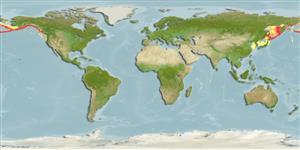
North Pacific: from the Bering Sea, south to Cape Mendocino, northern California, and far west to northern Japan.
Lunghezza alla prima maturità / Dimensione / Peso / Età
Maturità: Lm 122.0, range 112 - 132 cm
Max length : 161 cm TL maschio/sesso non determinato; (Ref. 56527); 154.0 cm TL (female); peso massimo pubblicato: 23.1 kg (Ref. 56527)
Breve descrizione
Chiavi di identificazione | Morfologia | Morfometria
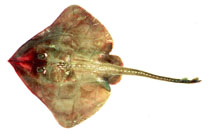
This large, rhomboidal skates (1,540 mm TL) have long head length 16.7-24.3% TL) and rounded pectoral apices; interdorsal space is large (1.3-3.1% TL); claspers short and stubby, with tip rounded and not bulbous, with weakly defined pseudosiphon, the dorsal lobe has a short pseudorhipidion, U-shaped cleft, while ventral lobe with a rounded projection; teeth in 34-42 rows on upper jaw, and 32-38 rows on lower jaw; pectoral radials 90; pelvic fins 22; total vertebrae 152; dorsal surface of body with fine prickles, becoming larger on the tail, also with thorns, with males having alar thorns, no malar thorns, middorsal thorns developed and high in number (4-11), nuchal thorns strong (3-5), scapular and tail thorns present, interdorsal thorns weak (1-2). Colouration: dorsal dark brown to grey, dark spots on pectorals, often with ocellus on either pectoral fin, while ventral white, with darker coloration on the snout, gills, disc margins, pelvics, and underside of the tail (Ref. 126515).
Cross section: flattened.
Found in deep waters, on outer continental shelf and upper slope, often over muddy sediments. Reported to feed mainly on benthic crustaceans, including shrimps and crabs, and secondarily on bony fishes (Ref. 126515). Oviparous. Distinct pairing with embrace. Young may tend to follow large objects, such as their mother (Ref. 205). Size at maturity for males 113 cm TL and 125 cm TL for females with males growing to at least 150 cm TL and females grow to about 154 cm TL; reported size at birth is 12-15 cm TL (Ref. 126515). Eggs are deposited in sandy or muddy flats (Ref. 205). Egg capsule measures 120-136 mm long and 73-90 mm wide (Ref. 41249, 41253); golden brown in color, and covered with coarse, striated, and anteriorly-directed prickles, giving it a velvety texture; the cases are with long, curved horns at each corner, with the anterior horns being short and these horns taper and become thin and filamentous at their ends (Ref. 126515).
Ciclo vitale e comportamento di accoppiamento
Maturità | Riproduzione | Deposizione | Uova | Fecondità | Larve
Oviparous, paired eggs are laid. Embryos feed solely on yolk (Ref. 50449). Distinct pairing with embrace. Young may tend to follow large objects, such as their mother (Ref. 205).
Knuckey, J.D.S. and D.A. Ebert, 2022. A taxonomic revision of Northeast Pacific softnose skates (Rajiformes: Arhynchobatidae: Bathyraja Ishiyama). Zootaxa 5142(1):1-89. (Ref. 126515)
Stato della Lista Rossa IUCN (Ref. 130435: Version 2025-2 (Global))
Minaccia per l'uomo
Harmless
Usi umani
Pesca: bycatch
Strumenti
Rapporti speciali
Scarica XML
Fonti Internet
Stime basate su modelli
Temperatura preferita (Fonte Biblio.
123201): 1.3 - 5.1, mean 2.3 °C (based on 239 cells).
Indice di diversità filogenetica (Fonte Biblio.
82804): PD
50 = 0.5000 [Uniqueness, from 0.5 = low to 2.0 = high].
Bayesian length-weight: a=0.00309 (0.00211 - 0.00452), b=3.11 (3.00 - 3.22), in cm total length, based on LWR estimates for this species & Genus-body shape (Ref.
93245).
Livello trofico (Fonte Biblio.
69278): 4.1 ±0.76 se; based on food items.
Resilienza (Fonte Biblio.
120179): Basso, tempo minimo di raddoppiamento della popolazione 4.5 - 14 anni (Fec assumed to be <100).
Vulnerabilità della pesca (Ref.
59153): Very high vulnerability (90 of 100).
🛈