>
Petromyzontiformes (Lampreys) >
Petromyzontidae (Northern lampreys) > Lampetrinae
Etymology: Eudontomyzon: eu-, a Greek intensive (good, well or very); odontos (Gr.) tooth, referring to numerous radially arranged teeth of E. danfordi; myzon (Gr.), to suck (borrowed from Petromyzon), referring to their suctorial behavior (See ETYFish); morii: In honor of zoologist Tamezo Mori (1884-1962), Hyogo Agricultural College (Japan), who provided holotype (See ETYFish).
Eponymy: Dr Tamezo Mori (1884–1962) was a Japanese ichthyologist, entomologist and ornithologist. [...] (Ref. 128868), visit book page.
More on author: Berg.
Lingkungan: lingkungan / zona iklim / kisaran kedalaman / jangkauan distribusi
Ekologi
; air tawar dasar (demersal); potamodromous? (Ref. 51243). Temperate
Asia: Yalu River basin, China and North Korea.
Ukuran / Berat / umur
Kematangan: Lm ? range ? - ? cm
Max length : 29.0 cm TL jantan/; (Ref. 89241)
Adults: 15.3-29.0 cm TL. Body wet weight of individuals 17.25-21.15 cm TL, 6.3-10.3 g. Body proportions, as percentage of TL (based on four specimens measuring 17.1-21.15 cm TL): prebranchial length, 11.7-13.0; branchial length, 8.7-10.2; trunk length, 47.0-47.5; tail length, 29.8-30.4; cloacal slit length, 1.2-1.7; eye length, 1.2-1.7; disc length, 6.1-7.2; prenostril length, 6.7-7.5; snout length, 7.6-8.7; postocular length, 2.8-3.1. Intestinal diameter, 0.3-0.4 cm. Trunk myomeres, 68-74. Dentition: Most labial teeth are villiform; supraoral lamina, 2 unicuspid teeth; infraoral lamina, 6-10 teeth, the lateralmost tooth on each side usually bicuspid, the internal ones unicuspid; 3 endolaterals on each side; endolateral formula, typically 2-2-2 (75%), but also 1-1-1 (25%); 3 rows of anterials; first row of anterials, 3-5 unicuspid teeth; 1-2 rows of exolaterals; 1 row of posterials; first (and only) row of posterials, 19-24 unicuspid teeth; transverse lingual lamina, 13-19 unicuspid teeth, the median one enlarged; longitudinal lingual laminae each with 14-15 unicuspid teeth. Velar tentacles, 9, with wings made up of two tentacles on each side. Lateral line neuromasts unpigmented. Extent of caudal fin pigmentation: 25% to under 75% (in 50% of specimens) and 75% or more (in the other 50%). Caudal fin shape, spade-like. Oral fimbriae, 95-100. Oral papillae, 16-22.
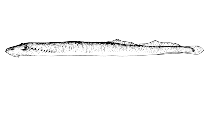
Body shape (shape guide): eel-like.
Burrows into substrate for the duration of the winter months (Ref. 33844). Freshwater. Adults parasitic on various fishes. Fecundity, 14,000-20,000 eggs/female (Ref. 89241).
Siklus hidup dan perilaku kawin
Kematangan | Reproduksi, perkembang biakan | Pemijahan | telur-telur | Fekunditas | Larva
Liu, C.-X. et al., 1987. Fauna Liaoningica. Liaoning Science and Technology Press, Shenyang, China. (Ref. 33844)
Status IUCN Red List (Ref. 130435: Version 2025-2 (Global))
ancaman kepada manusia
Harmless
penggunaan manusia
Perikanan: tidak ada kepentingan
Alat, peralatan
laporan khas
muat turun XML
Sumber internet
Estimasi berdasarkan model
Indeks keanekaragaman filogenetik (Acuan
82804): PD
50 = 0.5312 [Uniqueness, from 0.5 = low to 2.0 = high].
Bayesian length-weight: a=0.00132 (0.00060 - 0.00290), b=2.99 (2.80 - 3.18), in cm total length, based on LWR estimates for this (Sub)family-body shape (Ref.
93245).
Tingkat Trofik (Acuan
69278): 4.2 ±0.73 se; based on food items.
Daya lenting (Acuan
120179): Rendah, Waktu penggandaan populasi minimum 4.5 - 14 tahun (Semelparous species, assuming tm (= tmax) > 4).
Kerentanan Penangkapan Ikan (Ref.
59153): Low vulnerability (19 of 100).
🛈