>
Petromyzontiformes (Lampreys) >
Petromyzontidae (Northern lampreys) > Lampetrinae
Etymology: Eudontomyzon: eu-, a Greek intensive (good, well or very); odontos (Gr.) tooth, referring to numerous radially arranged teeth of E. danfordi; myzon (Gr.), to suck (borrowed from Petromyzon), referring to their suctorial behavior (See ETYFish); morii: In honor of zoologist Tamezo Mori (1884-1962), Hyogo Agricultural College (Japan), who provided holotype (See ETYFish).
Eponymy: Dr Tamezo Mori (1884–1962) was a Japanese ichthyologist, entomologist and ornithologist. [...] (Ref. 128868), visit book page.
More on author: Berg.
Môi trường: môi trường / vùng khí hậu / Mức độ sâu / phạm vi phân phối
Sinh thái học
; nước ngọt gần đáy; potamodromous? (Ref. 51243). Temperate
Asia: Yalu River basin, China and North Korea.
Bộ gần gũi / Khối lượng (Trọng lượng) / Tuổi
Chín muồi sinh dục: Lm ? range ? - ? cm
Max length : 29.0 cm TL con đực/không giới tính; (Ref. 89241)
Adults: 15.3-29.0 cm TL. Body wet weight of individuals 17.25-21.15 cm TL, 6.3-10.3 g. Body proportions, as percentage of TL (based on four specimens measuring 17.1-21.15 cm TL): prebranchial length, 11.7-13.0; branchial length, 8.7-10.2; trunk length, 47.0-47.5; tail length, 29.8-30.4; cloacal slit length, 1.2-1.7; eye length, 1.2-1.7; disc length, 6.1-7.2; prenostril length, 6.7-7.5; snout length, 7.6-8.7; postocular length, 2.8-3.1. Intestinal diameter, 0.3-0.4 cm. Trunk myomeres, 68-74. Dentition: Most labial teeth are villiform; supraoral lamina, 2 unicuspid teeth; infraoral lamina, 6-10 teeth, the lateralmost tooth on each side usually bicuspid, the internal ones unicuspid; 3 endolaterals on each side; endolateral formula, typically 2-2-2 (75%), but also 1-1-1 (25%); 3 rows of anterials; first row of anterials, 3-5 unicuspid teeth; 1-2 rows of exolaterals; 1 row of posterials; first (and only) row of posterials, 19-24 unicuspid teeth; transverse lingual lamina, 13-19 unicuspid teeth, the median one enlarged; longitudinal lingual laminae each with 14-15 unicuspid teeth. Velar tentacles, 9, with wings made up of two tentacles on each side. Lateral line neuromasts unpigmented. Extent of caudal fin pigmentation: 25% to under 75% (in 50% of specimens) and 75% or more (in the other 50%). Caudal fin shape, spade-like. Oral fimbriae, 95-100. Oral papillae, 16-22.
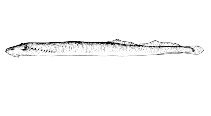
Body shape (shape guide): eel-like.
Burrows into substrate for the duration of the winter months (Ref. 33844). Freshwater. Adults parasitic on various fishes. Fecundity, 14,000-20,000 eggs/female (Ref. 89241).
Vòng đời và hành vi giao phối
Chín muồi sinh dục | Sự tái sinh sản | Đẻ trứng | Các trứng | Sự sinh sản | Ấu trùng
Liu, C.-X. et al., 1987. Fauna Liaoningica. Liaoning Science and Technology Press, Shenyang, China. (Ref. 33844)
Tình trạng Sách đỏ IUCN (Ref. 130435: Version 2025-2 (Global))
Mối đe dọa đối với con người
Harmless
Sử dụng của con người
Các nghề cá: không ích lợi (thú vị)
Các công cụ
Báo cáo đặc biệt
Tải xuống XML
Các nguồn internet
Ước tính dựa trên mô hình
Chỉ số đa dạng phát sinh loài (Tài liệu tham khảo
82804): PD
50 = 0.5312 [Uniqueness, from 0.5 = low to 2.0 = high].
Bayesian length-weight: a=0.00132 (0.00060 - 0.00290), b=2.99 (2.80 - 3.18), in cm total length, based on LWR estimates for this (Sub)family-body shape (Ref.
93245).
Mức dinh dưỡng (Tài liệu tham khảo
69278): 4.2 ±0.73 se; based on food items.
Thích nghi nhanh (Tài liệu tham khảo
120179): thấp, thời gian nhân đôi của chủng quần tối thiểu là 4.5 - 14 năm (Semelparous species, assuming tm (= tmax) > 4).
Sự dễ bị tổn thương của nghề đánh cá (Ref.
59153): Low vulnerability (19 of 100).
🛈