Elasmobranchi (squali e razze) (sharks and rays) >
Rajiformes (Skates and rays) >
Arhynchobatidae (Softnose skates)
Etymology: Bathyraja: Greek, bathys = deep + Latin, raja, -ae = a ray (Raja sp) (Ref. 45335).
More on author: Gilbert.
Ambiente: milieu / zona climatica / distribuzione batimetrica / gamma di distribuzione
Ecologia
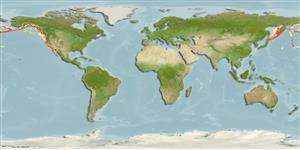
marino batidemersale; distribuzione batimetrica 213 - 2550 m (Ref. 80796). Deep-water; 63°N - 22°N, 144°E - 106°W
Northeastern Pacific: from the Bering Sea, south to gthe Gulf of California, Mexico, and to the west to the Sea of Okhotsk.
Dimensione / Peso / Età
Maturità: Lm ? range ? - ? cm
Max length : 91.0 cm TL maschio/sesso non determinato; (Ref. 87722); 89.0 cm TL (female); peso massimo pubblicato: 5.0 kg (Ref. 87722); Età massima riportata: 20 anni (Ref. 87722)
Breve descrizione
Chiavi di identificazione | Morfologia | Morfometria
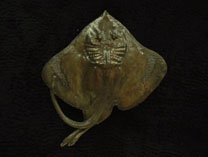
This moderately sized skates (91.0 cm TL) with disc length (28.7-56.7% TL) are distinguished by the following: pectorals broadly rounded, head length short (15.0-24.1% TL), preorbital length short (9.0-13.5% TL) are also distinguished by having the following: claspers short, tips relatively rounded, with large pseudosiphon and a strong, short pseudorhipidion, not reaching the tip, V-shaped cleft, projection absent; teeth in 27-36 rows on upper jaw and in 26-36 rows on lower jaw; pectoral fin radials 81; pelvics 23; total vertebrae 109; dorsal surface is covered with rough prickles, prickles on tail are larger and more robust; thorns on dorsal surface, mature males with alar thorns, no malar thorns, middorsal thorns weak or absent (0-1); nuchal thorns small or obsolete (0-3); tail thorns moderate (21-30); interdorsal thorns are small to occasionally absent (0-1). Colouration: dorsal dark purple, brown, or grey, spiracles occasionally pale, ventral coloration a lighter grey than dorsal surface, often with white blotching on mouth, gills, cloaca, and scattered across the body (Ref. 126515).
Cross section: flattened.
Inhabits deeper waters than hardnose skates and reported to prefer medium to cold temperatures and low oxygen environments compared to its congeners. It is found over a wide range of substrates, from fine sediment to rocky environments. Feeds mostly on benthic organisms, including annelids, shrimps, crabs, and fishes, with adults preferring fishes, whereas juveniles consume mostly invertebrates (Ref. 126515). Oviparous. Distinct pairing with embrace. Young may tend to follow large objects, such as their mother (Ref. 205). Reported size at maturity for males 74 cm TL and for females 80 cm TL with males growing to at least 90 cm TL and females at least 89 cm TL; with size at birth 9-16 cm TL. Maximum age reported estimated to be 20 years for males and 17 years for females. Egg cases small in size (6.2-7.8 cm TL), colour dark brown and becoming light golden brown on keels, which are smooth and plush-like when touched. Egg cases with long, slender horns at each corner, curving inwardly and slightly overlap at their tips with a distinct crossbar originating midway along the posterior horns in some specimens (Ref. 126515).
Ciclo vitale e comportamento di accoppiamento
Maturità | Riproduzione | Deposizione | Uova | Fecondità | Larve
Oviparous, paired eggs are laid. Embryos feed solely on yolk (Ref. 50449). Distinct pairing with embrace. Young may tend to follow large objects, such as their mother (Ref. 205).
Knuckey, J.D.S. and D.A. Ebert, 2022. A taxonomic revision of Northeast Pacific softnose skates (Rajiformes: Arhynchobatidae: Bathyraja Ishiyama). Zootaxa 5142(1):1-89. (Ref. 126515)
Stato della Lista Rossa IUCN (Ref. 130435: Version 2025-2 (Global))
Minaccia per l'uomo
Harmless
Usi umani
Strumenti
Rapporti speciali
Scarica XML
Fonti Internet
Stime basate su modelli
Temperatura preferita (Fonte Biblio.
123201): 2.2 - 5.2, mean 3 °C (based on 183 cells).
Indice di diversità filogenetica (Fonte Biblio.
82804): PD
50 = 0.5000 [Uniqueness, from 0.5 = low to 2.0 = high].
Bayesian length-weight: a=0.00447 (0.00278 - 0.00717), b=3.06 (2.92 - 3.20), in cm total length, based on LWR estimates for this species & Genus-body shape (Ref.
93245).
Livello trofico (Fonte Biblio.
69278): 4.0 ±0.7 se; based on size and trophs of closest relatives
Generation time: 12.2 ( na - na) years. Estimated as median ln(3)/K based on 2
growth studies.
Resilienza (Fonte Biblio.
120179): Basso, tempo minimo di raddoppiamento della popolazione 4.5 - 14 anni (Fec assumed to be <100).
Vulnerabilità della pesca (Ref.
59153): High vulnerability (57 of 100).
🛈
Nutrienti (Ref.
124155): Calcium = 6.64 [1.31, 32.87] mg/100g; Iron = 0.293 [0.070, 0.933] mg/100g; Protein = 15.7 [13.1, 18.2] %; Omega3 = 0.579 [0.189, 2.290] g/100g; Selenium = 16.2 [4.6, 50.1] μg/100g; VitaminA = 9.31 [2.07, 42.12] μg/100g; Zinc = 0.29 [0.15, 0.54] mg/100g (wet weight);