Lớp phụ Cá sụn (cá mập và cá đuối) (sharks and rays) >
Rajiformes (Skates and rays) >
Arhynchobatidae (Softnose skates)
Etymology: Bathyraja: Greek, bathys = deep + Latin, raja, -ae = a ray (Raja sp) (Ref. 45335).
More on author: Gilbert.
Môi trường: môi trường / vùng khí hậu / Mức độ sâu / phạm vi phân phối
Sinh thái học
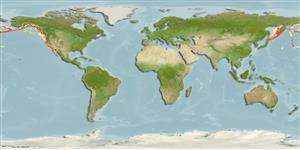
biển tầng đáy biển sâu; mức độ sâu 213 - 2550 m (Ref. 80796). Deep-water; 63°N - 22°N, 144°E - 106°W
Northeastern Pacific: from the Bering Sea, south to gthe Gulf of California, Mexico, and to the west to the Sea of Okhotsk.
Bộ gần gũi / Khối lượng (Trọng lượng) / Tuổi
Chín muồi sinh dục: Lm ? range ? - ? cm
Max length : 91.0 cm TL con đực/không giới tính; (Ref. 87722); 89.0 cm TL (female); Khối lượng cực đại được công bố: 5.0 kg (Ref. 87722); Tuổi cực đại được báo cáo: 20 các năm (Ref. 87722)
Mô tả ngắn gọn
Khóa để định loại | Hình thái học | Sinh trắc học
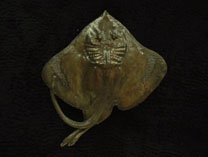
This moderately sized skates (91.0 cm TL) with disc length (28.7-56.7% TL) are distinguished by the following: pectorals broadly rounded, head length short (15.0-24.1% TL), preorbital length short (9.0-13.5% TL) are also distinguished by having the following: claspers short, tips relatively rounded, with large pseudosiphon and a strong, short pseudorhipidion, not reaching the tip, V-shaped cleft, projection absent; teeth in 27-36 rows on upper jaw and in 26-36 rows on lower jaw; pectoral fin radials 81; pelvics 23; total vertebrae 109; dorsal surface is covered with rough prickles, prickles on tail are larger and more robust; thorns on dorsal surface, mature males with alar thorns, no malar thorns, middorsal thorns weak or absent (0-1); nuchal thorns small or obsolete (0-3); tail thorns moderate (21-30); interdorsal thorns are small to occasionally absent (0-1). Colouration: dorsal dark purple, brown, or grey, spiracles occasionally pale, ventral coloration a lighter grey than dorsal surface, often with white blotching on mouth, gills, cloaca, and scattered across the body (Ref. 126515).
Cross section: flattened.
Inhabits deeper waters than hardnose skates and reported to prefer medium to cold temperatures and low oxygen environments compared to its congeners. It is found over a wide range of substrates, from fine sediment to rocky environments. Feeds mostly on benthic organisms, including annelids, shrimps, crabs, and fishes, with adults preferring fishes, whereas juveniles consume mostly invertebrates (Ref. 126515). Oviparous. Distinct pairing with embrace. Young may tend to follow large objects, such as their mother (Ref. 205). Reported size at maturity for males 74 cm TL and for females 80 cm TL with males growing to at least 90 cm TL and females at least 89 cm TL; with size at birth 9-16 cm TL. Maximum age reported estimated to be 20 years for males and 17 years for females. Egg cases small in size (6.2-7.8 cm TL), colour dark brown and becoming light golden brown on keels, which are smooth and plush-like when touched. Egg cases with long, slender horns at each corner, curving inwardly and slightly overlap at their tips with a distinct crossbar originating midway along the posterior horns in some specimens (Ref. 126515).
Vòng đời và hành vi giao phối
Chín muồi sinh dục | Sự tái sinh sản | Đẻ trứng | Các trứng | Sự sinh sản | Ấu trùng
Oviparous, paired eggs are laid. Embryos feed solely on yolk (Ref. 50449). Distinct pairing with embrace. Young may tend to follow large objects, such as their mother (Ref. 205).
Knuckey, J.D.S. and D.A. Ebert, 2022. A taxonomic revision of Northeast Pacific softnose skates (Rajiformes: Arhynchobatidae: Bathyraja Ishiyama). Zootaxa 5142(1):1-89. (Ref. 126515)
Tình trạng Sách đỏ IUCN (Ref. 130435: Version 2025-2 (Global))
Mối đe dọa đối với con người
Harmless
Sử dụng của con người
Các công cụ
Báo cáo đặc biệt
Tải xuống XML
Các nguồn internet
Ước tính dựa trên mô hình
Nhiệt độ ưa thích (Tài liệu tham khảo
123201): 2.2 - 5.2, mean 3 °C (based on 183 cells).
Chỉ số đa dạng phát sinh loài (Tài liệu tham khảo
82804): PD
50 = 0.5000 [Uniqueness, from 0.5 = low to 2.0 = high].
Bayesian length-weight: a=0.00447 (0.00278 - 0.00717), b=3.06 (2.92 - 3.20), in cm total length, based on LWR estimates for this species & Genus-body shape (Ref.
93245).
Mức dinh dưỡng (Tài liệu tham khảo
69278): 4.0 ±0.7 se; based on size and trophs of closest relatives
Generation time: 12.2 ( na - na) years. Estimated as median ln(3)/K based on 2
growth studies.
Thích nghi nhanh (Tài liệu tham khảo
120179): thấp, thời gian nhân đôi của chủng quần tối thiểu là 4.5 - 14 năm (Fec assumed to be <100).
Sự dễ bị tổn thương của nghề đánh cá (Ref.
59153): High vulnerability (57 of 100).
🛈
Chất dinh dưỡng (Ref.
124155): Calcium = 6.64 [1.31, 32.87] mg/100g; Iron = 0.293 [0.070, 0.933] mg/100g; Protein = 15.7 [13.1, 18.2] %; Omega3 = 0.579 [0.189, 2.290] g/100g; Selenium = 16.2 [4.6, 50.1] μg/100g; VitaminA = 9.31 [2.07, 42.12] μg/100g; Zinc = 0.29 [0.15, 0.54] mg/100g (wet weight);